
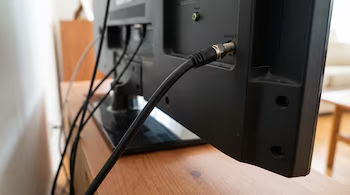
The Importance of Coaxial Cables for TV Signals
The quality of your television experience is significantly influenced by the type of cable connecting your TV to the antenna. One of the most reliable options is the coaxial cable, known for delivering clear images and sound without interference or distortions.
What is Coaxial Cable?
Coaxial cable is designed to transport radio frequency signals from antennas to receiving devices. It features two conductors aligned along the same axis, typically a copper core surrounded by a thick insulating layer and a braided metal mesh. This design prevents external interference while maintaining the integrity of the transmitted signal.
Structure and Function
The inner conductor, usually made from copper, carries the information while a thick insulating layer protects it. Surrounding this core is a braided metal mesh that acts as both a return conductor and a shield, stabilizing the electrical properties of the cable and shielding it from external noise. Finally, an outer layer provides further insulation.
This structural design ensures that the signal travels efficiently while minimizing the risk of loss or interference, crucial for maintaining high-quality image and sound transmission.
Advantages of Coaxial Cable
The primary benefit of coaxial cables is their ability to isolate the conductive core. This characteristic helps in maintaining a steady signal, ensuring your television experience is free from interruptions or distortions.
Coaxial cables are widely used in home television setups, urban cable networks, and closed-circuit surveillance systems. Despite advances in technology, such as optical fiber, coaxial still holds a significant role, especially in hybrid systems combining fiber and coaxial networks.
Common Uses of Coaxial Cables
Coaxial cables are primarily utilized to connect home televisions to antenna sockets. They can also be found in various applications, including:
- Broadcast systems: Some older versions of the Ethernet network used coaxial cables to transmit information.
- Professional audio and video equipment: Radio amateurs connect their transmitters to antennas using coaxial cables, and professional sound cards rely on them for high-quality signal integrity.
Types of Coaxial Cables
While various coaxial cable models exist, three are commonly used today:
- RG-6: This is the standard for most homes, supporting high-definition signals over long distances without significant signal loss.
- RG-59: An older, thinner, and less expensive option, RG-59 is suitable for short distances but not high-definition broadcasts. It finds use in video surveillance systems and specific broadcasting applications.
- RG-11: Known for its low signal loss and thicker construction, RG-11 is ideal for long-distance connections, such as high-definition antennas to receivers. However, its rigidity makes it less common for home setups.
To choose the best coaxial cable for residential use, RG-6 is generally recommended. RG-11 is reserved for specific long stretches, while RG-59 serves niche purposes.
Connecting Coaxial Cables
Connecting a coaxial cable is straightforward. Each cable has a male and female end; the male end connects directly to your TV’s corresponding port, while the female end inserts into the wall’s antenna socket. Identifying the coaxial cable is easy, as it is standard for receiving signals across all television types, old and new.
Conclusion
In an era where advanced technologies like optical fiber are available, coaxial cables still play a crucial role in providing a reliable and quality TV signal. Their inherent capability of minimizing interference ensures that both professional and home users continue to rely on them for exceptional audio and visual experiences.