
After spending two weeks with the Huawei Watch GT Runner 2 on my right wrist and the Garmin Forerunner 970 on the left, I realized I was looking at the wrong wrist. Once you have a solid reference in the running segment, transitioning to a different model can be challenging.
These two weeks have been a coexistence of two watches, each with its own philosophy yet serving the same purpose. The comparative analysis led to conclusions that might not align with what Huawei hoped for.
This assessment coincided conveniently with my time wearing the 970, the watch Huawei aims to dethrone. In its press materials, the GT Runner 2 is often positioned as superior—despite being nearly half the price.
Technical Specifications of the Huawei Watch GT Runner 2
HUAWEI WATCH GT RUNNER 2 | |
|---|---|
DIMENSIONS | 43.5 × 43.5 × 10.7 mm |
WEIGHT | 43.5 g (with strap) / 34.5 g (without strap) |
SCREEN | AMOLED, 3,000 nits |
GLASS | 2nd generation Kunlun Glass |
HOUSING | Aerospace-grade titanium alloy |
BATTERY | 540 mAh / up to 14 days normal use / 32 hours outdoor training |
GPS | Dual-band, all systems (GPS, GLONASS, Galileo, BeiDou, QZSS) |
HEART RATE | Continuous, 99% accuracy vs. chest strap |
HEALTH | ECG, arrhythmia detection, continuous heart rate variability (including sleep), SpO2 |
STRAP | Nylon AirDry + fluoroelastomer (22 mm standard) |
COMPATIBILITY | iOS and Android |
APP | Huawei Health (AppGallery, App Store, Galaxy Store) |
PAYMENTS | Independent NFC |
PRICE | 399 euros |
A Watch with One Size (and What It Implies)
One of the first things you notice before even turning it on is that the GT Runner 2 comes in one size. Huawei offers a 43.5 mm case termed “unisex,” which sounds fair on paper, but is debatable on the wrist.
Used to the 47 mm size of the 970, the Huawei feels somewhat small to me. While that’s not a drastic difference, it’s noticeable enough each time I glance at it. My wife, coming from a 40 mm watch, feels the opposite—it seems a bit large for her. The “unisex” designation is similar to “one size fits all” in clothing: theoretically for everyone, but in practice, it suits only a specific range.
This size decision simplifies manufacturing logistics but, in my opinion, excludes a significant part of the audience Huawei aims to attract. Those accustomed to larger sports watches tend to prefer them that way. I’m convinced future generations will offer two sizes to meet demand. If your reference point is a 47 or 49 mm model, be prepared to notice the shift.
The design, apart from size, is solid. The titanium casing is thin, with a strap oriented towards running: breathable with no seams that irritate over long distances. It fits well during runs, not impeding movement or overheating. This watch seems designed to be forgotten on your wrist, which is precisely what a good sports watch should do. That said, I ended up switching to the other strap that comes in the box (a nice touch), made of fluoroelastomer.
The Battery: Good, But Not What They Promise
The battery is the first key selling point, and precision here is crucial. Huawei states “up to 14 days of normal use.” However, during my week with lower-than-usual activity due to a trip to the MWC (four one-hour strength sessions and two runs of 8.6 and 7.5 km, respectively, along with occasional consultations, and continuous heart rate and SpO2 monitoring), I dropped from 100% to 5% in exactly seven days.
Is this a bad figure? Not at all. A week with actual training is a fairly honest and competitive number. However, it’s essential not to oversell the 14 days since such figures are achievable only under conditions that few real runners will meet. Comparatively, the Forerunner 970 lasts around twelve or thirteen days under a similar usage profile. The difference is not dramatic, but it exists.
Where the Huawei Outshines My Garmin
One area where Huawei excels is in the optical heart rate sensor responsiveness. It’s one of those details not covered in tech specs but felt daily. The GT Runner 2 responds quicker: when effort spikes, the watch reflects it earlier; similarly, when you slow down, the decrease registers faster as well. The 970 has some inertia, presenting a slight delay that creates a sense that the watch always lags behind the body’s awareness of effort.
The Huawei accurately reflects the real-time effort sensations. This is no minor detail: for a watch claiming to assist you during training, prompt heart rate feedback is substantial.
Metrics for Runners, Not Casual Athletes
The GT Runner 2 brings features that are not common in smartwatches with added sports functionality. It should be assessed as a sports watch with smart capabilities, not the other way around. Within this framework, it boasts high-end running elements: stride length analysis, cadence, ground contact time, and vertical oscillation. Some metrics found in other ecosystems require additional accessories, but Huawei integrates them as standard, displaying results in a reasonably self-explanatory manner.
This is where the watch pleasantly surprises:
- Garmin, with years of experience and greater metric depth, sometimes errs on the cryptic side: there are data points that users actively have to seek out to understand what they measure and why.
- The GT Runner 2 provides solid information depth, often with enough context to understand what’s being measured. The learning curve is more approachable, though not trivial.
However, the interface carries a significant flaw that surprisingly irritates due to its apparent gravity: texts that do not fit the screen scroll horizontally to be fully displayed. While you’re waiting for the text to finish, you lose time and focus.
Forecasting Algorithms Still Learning
Race predictions are another point of contention. The GT Runner 2 provides estimated times for standard distances (5K, 10K, half marathon, and marathon) that tend to be pessimistic. Not excessively so, but consistently: my real times and personal bests are systematically better than what the watch predicts.
Here’s a table comparing forecasts from Huawei, Garmin, Strava, and my best performances over the past year:
RACE PREDICTIONS | HUAWEI WATCH GT RUNNER 2 | GARMIN FORERUNNER 970 | STRAVA | PERSONAL BEST (LAST 12 MONTHS) |
|---|---|---|---|---|
5 km | 4:20/km | 4:08/km | 4:11/km | 4:05/km |
10 km | 4:28/km | 4:21/km | 4:19/km | 4:11/km |
21 km | 4:38/km | 4:30/km | 4:26/km | 4:28/km |
42 km | 4:54/km | 5:00/km | 5:13/km | 5:28/km |
The Forerunner 970, with more data history on me, aligns much closer to reality and did so fairly quickly after I started using it. Strava also performs better in matching my actual benchmarks compared to Huawei.
In contrast, the VO2 max estimates from the GT Runner 2 are slightly higher than the Garmin’s (54 vs 53). While optimistic about aerobic capacity, it tends to be pessimistic regarding predicted times. This strange combination suggests the algorithms are still fine-tuning their calibration. With more usage and accumulated data, those predictions should improve. But for now, someone coming from an established watch will find the forecasts unreliable.
Another oddity: the calories estimates by the Huawei always tend to be significantly higher than those of the Garmin. The Garmin’s figures are nearly identical to what my previous Apple Watch Ultra 2 calculated.
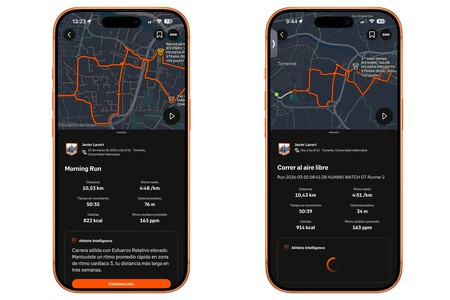
To wrap up this section, it’s worth noting that while the Huawei can integrate with Strava, it requires a roundabout method due to the absence of Google services and Google Play. Moreover, once done, any shared activity appears somewhat crude and less refined. Here’s a comparison of data between the Garmin and Huawei:
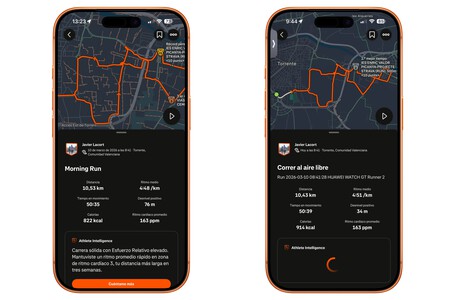
On the left, the Garmin activity in Strava. On the right, the Huawei activity synced via Health Sync, with a less appealing automated text. Also worth noting, it estimated calories 11% higher but shortened distance by 100 meters, which worsened the pace. The average heart rate is identical though. Image: Xataka.
Value for Money
The GT Runner 2 aims to be a Garmin or Coros at half the price. In part, it succeeds, but the most honest comparison isn’t with the Forerunner 970 or Coros Pace 4 Pro—it’s with watches one tier lower in the range. Here, the Huawei holds its own and presents a hard-to-argue price proposition.
However, there is an ecosystem behind the major players in running that the GT Runner 2 still cannot replicate. The integration with Strava is functional but basic, as previously discussed. The community, historical data, routes, and training plans: all of these exist in the Huawei Health world, but with less critical mass, fewer third-party integrations, and less accumulated depth.
For someone starting fresh, this may not matter. But for anyone already entrenched in the Garmin or Suunto ecosystem, the cost of change is real and not reflected in the watch’s price.
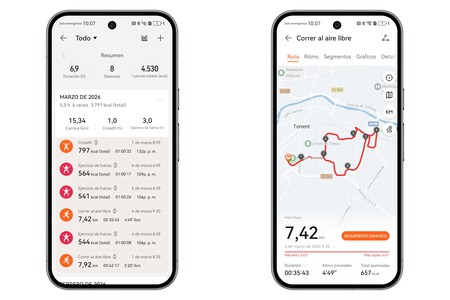
The touted GPS performs well. The mobile app allows for viewing training details and physical status. Image: Xataka.
The GPS performance, however, is excellent; the updated antenna does a solid job in urban and open-field routes, delivering precise traces with minimal deviations in weak signal moments. The dual-band mode helps in this respect, as noted in path comparisons between the GT Runner 2 and the 970: the differences are minimal, sometimes non-existent.
After two weeks, the Huawei Watch GT Runner 2 leaves me with a specific feeling: it’s an honest watch, well-built, with in-depth metrics and an optical sensor response that surpasses my standard model in some specific aspects.
The single size option is a limitation that would be decisive for me personally: if I can’t buy it in a larger size, I won’t purchase it. Furthermore, the predictive algorithms require more time or adjustment to be reliable from the get-go.
However, if you’re coming in without prior baggage, without an accumulated ecosystem, and with a budget constraint, the GT Runner 2 presents a serious argument. It’s unlikely to be the best running watch on the market, but it’s one of the most interesting in its price range. The fact that Huawei is in this conversation is news in itself. I’m confident that this team will continue to compete until there’s no doubt they are serious contenders for the crown.
For now, that remains to be seen.
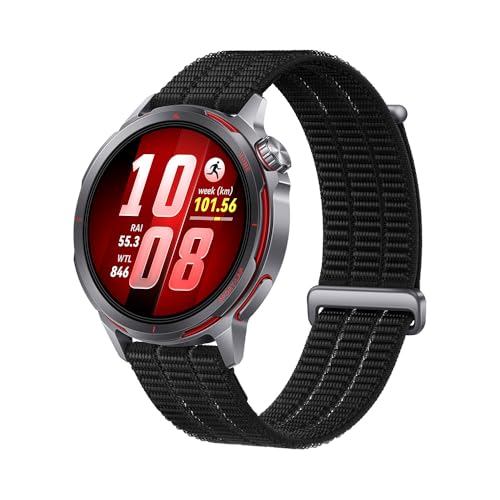
HUAWEI Watch GT Runner 2 Black
This device was provided for review by Huawei. You can read more about our review process at Xataka and our policy on relationships with companies.