
Airbus A350-1000ULR: A New Milestone in Aviation
After 24 hours and 24 minutes without touching land, a Airbus A350-1000ULR landed this Tuesday in Toulouse. This historic flight didn’t carry commercial passengers but was equipped with pilots, engineers, five tons of instrumentation, and over a thousand sensors to monitor the aircraft’s performance during its prolonged flight. This venture by Qantas and Airbus signals a revolution in long-haul aviation as they gear up to make some of the longest flights ever planned part of regular services.
Test Route Overview
The route taken by the A350-1000ULR wasn’t aimed at establishing a new commercial route. The aircraft took off from Melbourne, traveled northeast over the Pacific, crossed the U.S. and Canada, followed by a journey across the Atlantic before eventually landing in southern France. Toulouse was a fitting destination, as it is home to the A350’s final assembly line. The mission aimed to demonstrate a block time of 23 hours, providing ample leeway for taxiing, waiting, or any necessary detours.
Flight Development and Capabilities
This test was not an isolated event; the first A350-1000ULR had debuted on June 2. Airbus has spent weeks analyzing the advances made for this aircraft. They categorize this mission as a flight of development, not a commercial service or complete certification. The objective was to gather valuable data concerning fuel management and cabin climate control, laying the groundwork for future certifications and regulatory approvals.
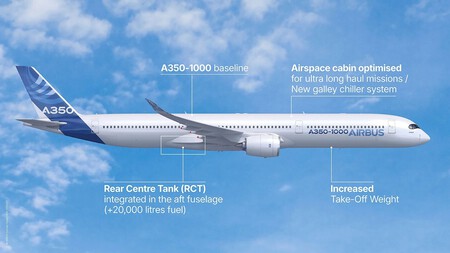
The A350-1000ULR enhances the A350-1000 with increased fuel capacity and systems designed for extended missions.
Technical Specifications and Autonomy
The aircraft’s enhanced autonomy stems from a central rear fuel tank with a capacity of 20,900 liters, built directly into the structure of the aircraft. This design necessitated significant adjustments to the fuel management system, ensuring a balance of weight throughout the flight. Retaining the Rolls-Royce Trent XWB-97 engines from the standard A350-1000, this model is modified to handle missions lasting approximately 22 hours while meeting the required operational margins.

Flightradar24 documented the A350-1000ULR’s arrival after achieving over 24 hours in the air, covering 16,889 kilometers.
Qantas Chooses Airbus Over Boeing
Throughout this competitive landscape, Boeing also sought to win the Qantas program by proposing the 777-8 from the 777X family as a contender for ultra-long routes. Ultimately, however, Qantas opted for the A350-1000 in 2019, finalizing an order for 12 units in May 2022. The airline cited favorable commercial terms, fuel efficiency, low operating costs, and outstanding passenger experiences as deciding factors.
The Future of Long-Haul Travel
Flying for nearly an entire day may not be entirely new; we have seen earlier demonstrations, such as Qantas’s 1989 record flight from London to Sydney. The real challenge lies in transitioning such endurance into practical daily routes.

Recreation of a First suite on the future Qantas A350-1000ULR.
With a low-density cabin of just 238 seats, Qantas aims to offer more comfort, sacrificing maximal capacity for better passenger experience. The layout includes six first-class suites and 52 business class seats. Qantas plans to initiate these services between Sydney and London in October 2027, marking a pivotal moment in redefining long-haul air travel.