
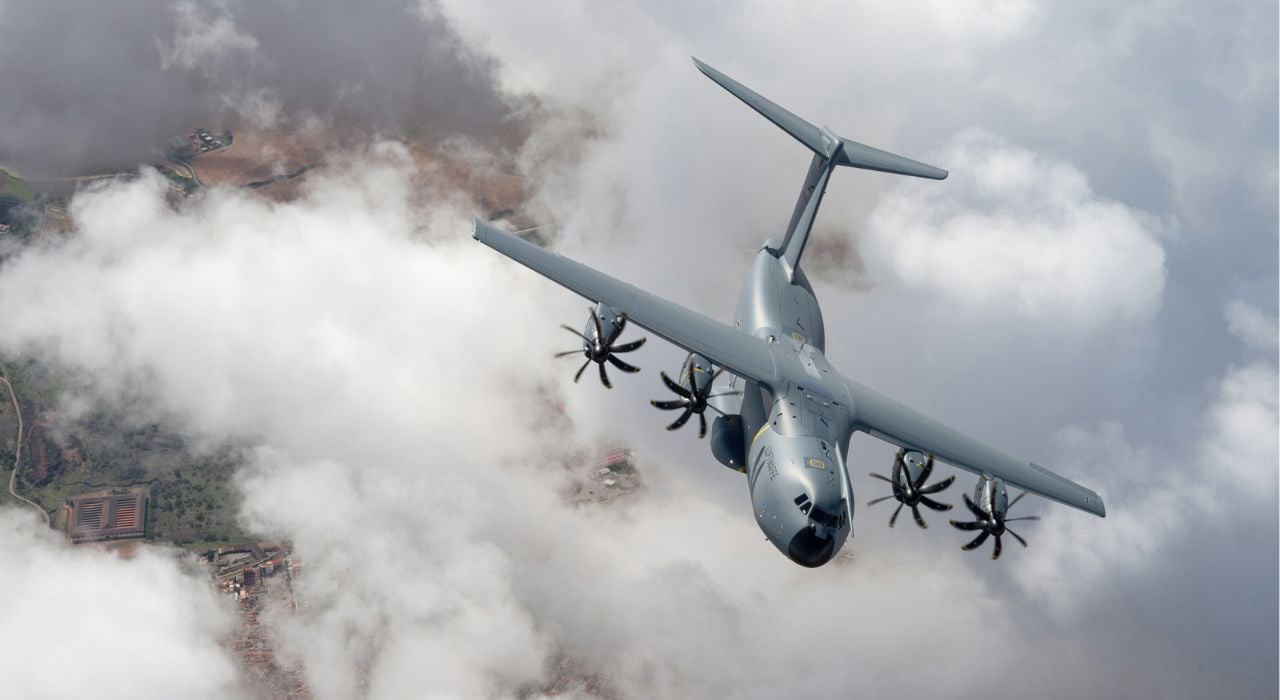
Transporting troops, refueling in flight, evacuating the wounded: the A400M is a multitasking aircraft . For several years, it has been the backbone of the Bundeswehr’s air operations. However, these missions carry increasing risks, particularly with the threat of surface-to-air missiles equipped with infrared seeker heads. To counter this, Germany is now equipping 23 of its A400M aircraft with a new generation optical defense system: DIRCM.
What is DIRCM and Why Deploy It?
DIRCM stands for Directed Infrared Counter Measures. It is an active defense system designed to disrupt enemy missiles that home in on a target using its thermal signature. Essentially, DIRCM detects an incoming missile and directs a laser beam towards it to scramble its infrared sensor.
This type of threat is common in conflict zones. A simple man-portable missile (known as MANPADS), often available on the black market, can be sufficient to down an unprotected transport aircraft. With DIRCM, A400M planes gain a level of autonomous, automated protection that operates in real-time without human intervention.
Integration Scheduled Until 2032
The contract signed between Airbus and Germany’s Federal Office of Bundeswehr Equipment (BAAINBw) includes the installation of DIRCM on 23 aircraft used for tactical operations. These planes conduct missions in unstable environments: medical evacuations, deployments in war zones, and airdrops in hostile territory.
The system will be supplied by Elbit Systems, an Israeli company specializing in defense electronics. Integration will take place at Airbus facilities in Manching (Germany), Getafe, and Seville (Spain) during scheduled maintenance periods, minimizing operational downtime.
Certification of the system is expected by summer 2025. Integration work will continue through to 2032.
Integrated and Modular Defensive Architecture
Not all A400M aircraft are destined for the same missions. Those assigned to intercontinental logistics (transporting heavy equipment, armored vehicles, or helicopters) will not be equipped with DIRCM. The system targets exclusively aircraft exposed to surface-to-air threats during operations close to the ground.
This means that the defensive architecture is now tailored to mission profiles. This is a significant step in the modular design of military aircraft: each component becomes optional based on actual usage.
Active, Automated, and Precise Laser Technology
DIRCM relies on a combination of infrared sensors, optical tracking systems, and a high-frequency laser. The beam is directed with high precision towards the missile’s warhead, causing disorientation of its thermal guidance system.
Unlike passive thermal flares, this technology works actively and specifically against the identified missile, rather than merely distracting all surrounding threats.
The laser used is harmless to the crew and allied equipment. It is calibrated to operate at a distance and specifically against sensitive thermal sensors.
Why This Matters to Applied Sciences in High School
The implementation of DIRCM serves as an excellent example of applied physics and advanced engineering. It encompasses several interrelated disciplines:
- Optics and infrared: detection, focusing, thermal absorption.
- Robotics and kinematics: dynamic beam orientation.
- Power electronics: supplying power in a constrained aerial environment.
- Automation and embedded intelligence: instant reaction without human intervention.
Understanding these systems allows specialty science students to connect theoretical lessons to concrete, strategic applications. It presents a unique opportunity to explore the relationships between defense, innovation, and modern physics.
A Future Standard for High-Risk Missions
By integrating DIRCM, the A400M marks a significant advancement in the active protection of its crews. Such countermeasures had previously been reserved for fighter jets or combat helicopters. Its adaptation to a tactical transport aircraft illustrates the evolving threats on the battlefield and the technological responses from industry.
The coming years will validate the system’s effectiveness in the field. If flight tests prove successful, this technology could become a standard for all military fleets operating in crisis zones.