
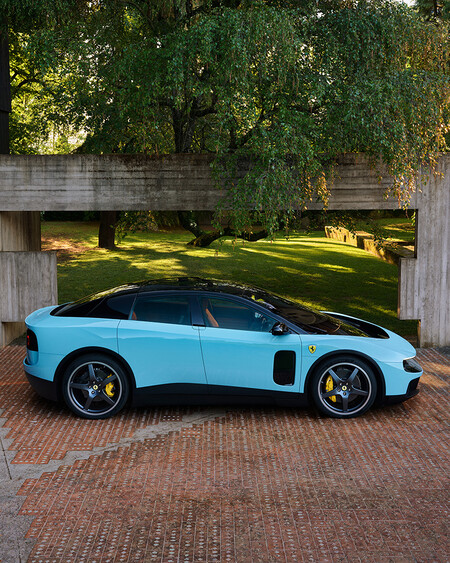
Ferrari has made a bold statement with the introduction of the Luce, its first electric car that debuted on May 25, 2026, in Rome, marking a significant evolution for the iconic brand. This launch not only transitions from gasoline to electric power but challenges the traditional boundaries of Ferrari’s design and engineering prowess.
Emphasizing Legacy and Innovation
The choice of launch date is symbolic, commemorating Ferrari’s first victory in 1947 at the Grand Prix di Roma. The Luce represents more than just another vehicle; it signifies Ferrari’s willingness to adapt and innovate while honoring its storied heritage. This car is the inaugural result of Ferrari’s 2022 multi-energy strategy, which emphasizes the coexistence of electric, hybrid, and combustion technologies.
A New Architectural Approach
What stands out immediately about the Luce is its innovative design. Unlike previous models, this is the first Ferrari where buyers can opt for a five-seat configuration in a series production car. The unique electrical architecture allows for a battery placement beneath the floor and rear seats, resulting in a spacious cabin free from the constraints of a central tunnel that was typical in traditional setups.
Collaboration with Design Visionaries
Perhaps the most noteworthy aspect of the Luce is its design. Ferrari turned to LoveFrom, a creative collective spearheaded by renowned designer Jony Ive, to sculpt the car’s aesthetic. This departure from the in-house design team signifies a fresh and modern language that permeates not just the exterior, but also the interior and user interface of the vehicle.
A Futuristic Look and Feel
The Luce’s silhouette has been described as a “glass house,” with a smooth, shell-like form that flows around the car. Aerodynamic features and transparent panels enhance its contemporary look, while the nostalgic halo taillights nod to famous models like the 360 Modena and the 458 Italia, balancing modernity with tradition.
Intuitive Interior Design
Inside, the Luce aims to merge physical and digital interfaces seamlessly. Instead of overwhelming users with screens, Ferrari implements a blend of aluminum controls, dials, and OLED displays from Samsung, placing essential information right in front of the driver. This design philosophy respects both mechanical sensibilities and the conveniences of digital technology.
Impressive Performance Specifications
In terms of performance, the Luce does not disappoint. It boasts a staggering 1,050 horsepower available in Launch Control mode, powered by four electric motors—one for each wheel. The vehicle features a 122 kWh battery and an 800 V architecture, enabling acceleration from 0 to 100 km/h in just 2.5 seconds and reaching a top speed of 310 km/h. The estimated range stands at approximately 530 kilometers, although this figure awaits formal homologation.
Unique Acoustic Experience
Sound engineering receives particular attention in the Luce as well. Rather than artificial sound generation, Ferrari developed a system that amplifies genuine mechanical vibrations from the electric axles. This technology enhances the driving experience, adapting sounds in real-time based on the selected driving mode via the e-Manettino switch.
Market Position and Pricing
As for the price, the Luce is positioned in the ultra-premium sector, with estimates exceeding €500,000. Potential buyers can explore configuration options through Ferrari’s official website, although direct purchases are yet to be enabled.
In conclusion, the Ferrari Luce is not just an electric car; it is a transformative vehicle that blends heritage with modernity, pushing the boundaries of what an electric supercar can be. As the automotive world evolves, Ferrari’s commitment to tradition while embracing the future exemplifies a remarkable shift in the high-performance car landscape.