
The Fragile State of Europe’s Internet Connectivity
The Red Sea’s Critical Role in Global Data Traffic
Approximately 99% of international internet data traffic relies on fiber optic cables that traverse beneath the seas and oceans. A unique visual resource exists, akin to Google Maps, that maps the paths of these underwater cables. Certain areas reveal substantial networks of cables, while others appear as vast wastelands. The Red Sea, however, is particularly significant, accommodating 90% of Europe-Asia cable capacity yet remaining fraught with geopolitical instability.
In peaceful times, these cables operate seamlessly. However, amidst conflicts, they are vulnerable to sabotage. For instance, a Houthi missile strike in 2024 impacted a cargo ship, severing three underwater cables, with repairs delayed by months. This vulnerability has led to Europe searching for alternative routes, particularly around the North Pole.
Introducing Polar Connect: A Strategic Cable Initiative
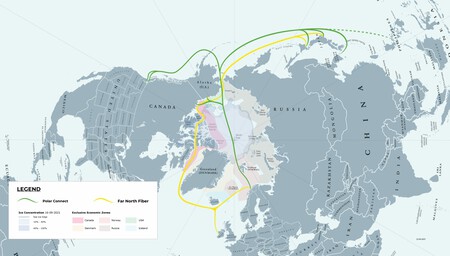
To mitigate this risk, the European Union has proposed the Polar Connect initiative, championing the construction of two Arctic cables. One path will traverse the Canadian Northwest Passage, while the other directly crosses the North Pole, aiming to establish a vital connection between Scandinavia and Asia.
The EU has already designated Polar Connect as a “Cable Project of European Interest”, with initial funding in place and an anticipated completion date by 2030. The collaborative effort involves prominent partners, including the Nordic research and education network NORDUnet and various network operators.
Importance of the Polar Connect Initiative
Submarine cables serve as the essential arteries of global communication, facilitating corporate exchanges, cloud services, and financial transactions. The existing reliance on routes vulnerable to conflict heightens the risk of regional outages. Polar Connect aims to alleviate these geopolitical concerns while enhancing data transmission efficiency.
The project’s timing is crucial, as tech giants like Meta, Google, and Microsoft now account for over 70% of submarine cable capacity globally. Currently, Europe lacks sovereign routes to Asia, relying on problematic alternatives like the Red Sea and passing through either Russia or the United States.
Historical Context and Geopolitical Considerations
The geopolitical landscape surrounding the Red Sea has been turbulent since the 1950s, marked by multiple conflicts, while the Arctic region’s past necessitated partnerships with Russia. The ongoing Ukraine war has shifted the dynamics, rendering the North Pole corridor a new focus. However, past attempts to deploy cables in Arctic conditions, such as the Quintillion project, have encountered significant challenges, primarily due to ice-related disruptions.
Navigating the Challenges Ahead
Polar Connect aims to bridge the Nordic region to Japan and South Korea via fiber optic cables under the Arctic Ocean, with funding already approved for preliminary phases. This project includes advanced environmental sensors, allowing it to function as both communication infrastructure and a scientific research tool. Additionally, it is complemented by another initiative, Far North Fiber, which will utilize the Canadian Northwest Passage for added redundancy.
Conclusion: The Road Ahead
Despite its promises, the challenges of designing, building, and maintaining underwater cables are formidable. Key concerns include the risk of ice scour, which could expose cables to damage during harsh winter conditions. Experts, including Alan Mauldin from TeleGeography, emphasize the complexity of Arctic cable projects, highlighting the necessity of innovative solutions for successful implementation.
In summary, while the construction of Polar Connect holds significant potential for enhancing Europe’s internet connectivity and reducing geopolitical risks, it needs to navigate geographical and logistical hurdles effectively.