
Monitoring Road Safety: The DGT’s Expanding Arsenal
Little by little, without making much noise, the DGT (Dirección General de Tráfico) has been expanding its horizons. First, there were speed cameras. Then came mobile controllers and the use of helicopters. Over the years, there has been a continuous expansion of cameras to monitor the use of seat belts and mobile phones.
And now, the focus is on continuous lines.
By Land… and Air. In Spain, there are currently a total of 3,395 devices active to control speed or any other type of infraction, according to data collected by Faconauto. These data not only include the DGT controllers but also take into account that the Basque Country and Catalonia have transferred powers, allowing municipalities to have their own devices.
According to the DGT itself, which compiles the position of all its radars on its website, in Spain there are more than 1,300 points monitored through fixed and mobile radars. Additionally, it should be noted that the DGT has empty boxes distributed throughout the national territory as an intimidating measure.
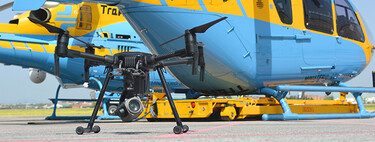
To these systems, we must also add the performance of Pegasus, the DGT helicopters that pursue speeding from the air. These leading teams, however, seem to have become somewhat obsolete when compared to the technological advancements made by teams in Catalonia.
Not Just Radars. In this aerial surveillance, the DGT doesn’t solely rely on speed radars. The public entity has more than 200 cameras monitoring seat belt use and mobile phone usage. Violating these rules can result in significant penalties: €200 and four points for not wearing a seat belt and €200 with six points lost for using a mobile phone.
Moreover, in recent times, the DGT has introduced a new type of controller. Utilizing cameras, the agency can detect if a driver skips a stop sign or a continuous line. Both infractions are punishable by a fine of €200, categorized as serious violations.
Madrid as a Laboratory. Of the latest continuous line control cameras, four have been registered by the DGT and are located in Madrid. This region is emphasized by the DGT, with all cameras situated near the capital.
According to the DGT’s data, these cameras are located at the following points:
Camera Type | Road | Kilometer Point | Direction |
|---|---|---|---|
Continuous Line | A1 | 15.95 | Decreasing |
Continuous Line | A2 | 11.8 | Decreasing |
Continuous Line | A42 | 16.9 | Decreasing |
Continuous Line | A6 | 20.2 | Decreasing |
And How Do They Work? The system, as explained by the DGT, is simple. A camera in each lane detects which cars are traveling in each direction at the beginning of the monitored section. The cameras record the license plates of the passing vehicles. At the end of the controlled section, the camera again records cars. If the second recording does not match the first, it’s clear: the driver has violated the continuous line.
If a vehicle’s license plate is recorded by the same camera at both monitored points, that vehicle has not changed lanes. This intricate system is part of the DGT’s strategy to promote safer driving behaviors across the country.