

Intel’s Panther Lake: A Promising Future for Chip Technology
Intel needs a break , and Panther Lake could be its saving grace. The tech giant has just unveiled its new System-on-Chips (SoCs) that utilize 18A photolithography , expected to hit laptops and various devices, including portable consoles, by early 2026 . This new chip family promises significant advancements, but will it meet expectations amid Intel’s ongoing struggles?
The Significance of Panther Lake
These new Panther Lake chips, part of the Intel Core Ultra Series 3 , are the first to be constructed using the 18A photolithography node , which equates to approximately 2 nm. This technological leap is crucial for Intel, particularly as it battles the greatest crisis in its history. The company asserts that this 18A process could yield up to 15% more performance per watt and enhance chip density by 30% compared to its predecessors.
Made in the USA: A Homegrown Solution
The official press release highlights that these chips will be produced at the newly inaugurated Fab 52 in Chandler, Arizona. This initiative aligns with the U.S. government’s goal to reduce reliance on Asian manufacturers, particularly China. The country recently acquired 10% of Intel to strengthen its position as a “chip producer,” making this a potentially groundbreaking development for domestic chip manufacturing.
Understanding Fab 52
Fab 52 is an immense manufacturing facility covering over 280 hectares — roughly equivalent to 400 football fields . Intel executive Kevin O’Buckley boasted that it employs “the most advanced semiconductor production technology today on planet Earth.” This bold claim comes amid competition from giants like TSMC and Samsung , who have increasingly outpaced Intel in technological advancement.
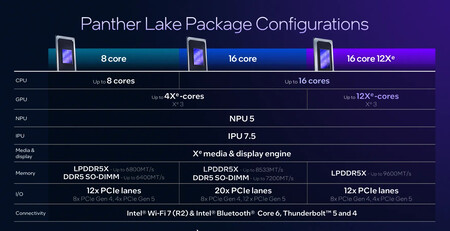
A High-Performance CPU Configuration
The Panther Lake SoCs feature a CPU configuration of up to 16 cores , combining high-performance Cougar Cove (P-cores) and efficient Darkmont (E-cores). Performance metrics indicate a 40% improvement in single-threaded tasks and a 50% boost in multi-threaded tasks compared to previous generations, such as Lunar Lake. If these assertions hold true, Panther Lake is set to redefine performance standards.

Enhanced GPU Capabilities
For those seeking graphical prowess, the Panther Lake SoCs also shine in this area. The variant with 12 new Xe3 cores promises to be 50% more performant than the previous generation with 8 Xe2 cores . This boost in both core count and efficiency is a significant selling point for gamers and graphics professionals alike.

AI Capabilities Take a Leap
In the realm of artificial intelligence , the new NPU 5 in Panther Lake SoCs is touted to deliver impressive performance with 180 TOPS , a remarkable jump from its predecessors, which capped at 50 TOPS . This improvement facilitates running local AI models effectively. Furthermore, support for up to 96 GB of LPDDR5 memory featuring the new LPCAMM format further enhances the capabilities of these advanced chips.
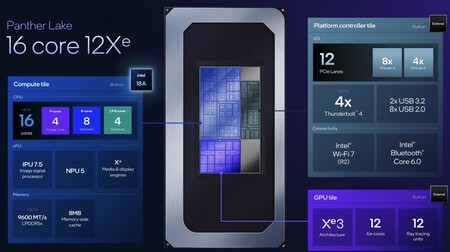
The most ambitious version of the Panther Lake SoC has multiple advanced features…
Looking Ahead: Unknowns Remain
Despite the exciting prospects, details regarding specific models and pricing remain under wraps. The Panther Lake SoCs are aimed at laptops and portable consoles, and it’s likely that we’ll witness the first devices utilizing these chips at the upcoming CES electronics fair in Las Vegas.
Everything Still to Prove
While the technical specifications paint a bright picture, actual performance in the market will determine Intel’s fate. Both the performance of the chips and the firm’s commitment to U.S.-based manufacturing mark a critical point in Intel’s long-term strategy, especially given its alignment with governmental initiatives. It remains to be seen if Panther Lake can live up to the hype and help revive Intel’s standing in a competitive landscape.