

What impact did the dip in Bitcoin’s price have on Tesla’s reported holdings? How does the FASB rule change affect how companies, including Tesla, report their cryptocurrency assets? What are the main factors contributing to the decline in Tesla’s Q1 revenue and net income?
Tesla reported holding $951m in Bitcoin at the end of the first quarter, maintaining its position as one of the largest corporate holders of the cryptocurrency. The figure, disclosed in its earnings release on Tuesday, is down from $1.076b at the close of December, reflecting the dip in Bitcoin’s price during the quarter. Tesla did not sell any of its holdings, according to on-chain data from Arkham Intelligence.
Tesla continues to hold 11,509 Bitcoin, a position it began accumulating in early 2021 when it became the first major automaker to add the digital asset to its balance sheet.
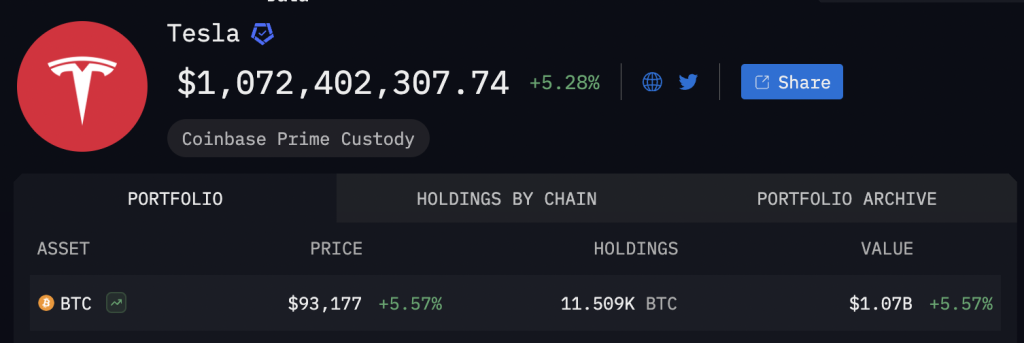
Image Source: Arkham
FASB Rule Change Lifts the Lid on Unrealized Bitcoin Gains
This isn’t the first time Tesla’s financials have reflected the impact of new accounting standards for digital assets. The latest figure comes under the Financial Accounting Standards Board’s updated rule requiring companies to mark crypto holdings to market each quarter. Previously, companies had to record the lowest value of the asset during the reporting period, often obscuring unrealized gains. The change now allows firms like Tesla to present a more accurate view of their digital asset positions.
It also comes at a time when institutional confidence in Bitcoin is strengthening, despite ongoing macroeconomic uncertainty.
Q1 Earnings Fall Short as Tesla Battles Cost Pressures and Slowing Demand
Total revenue declined 9% to $19.3b, down from $21.3 billion a year ago. Automotive revenue fell 20%, dropping to $14b from $17.4b in the same quarter last year. Net income plunged to $409m, or 12 cents per share, down sharply from $1.39b, or 41 cents, a year earlier. The company did not issue new growth guidance for the year and said it would revisit its 2025 outlook in the next quarter.
CEO Elon Musk has been spending significant time in Washington, working with the Trump administration on a broad plan to reduce the size of the federal government. The White House’s sweeping tariff policy has raised concerns for EV manufacturers, as higher import costs for key inputs such as battery components, circuit boards and specialty glass threaten to erode margins.
The post Tesla Posts $951M in Bitcoin Holdings Despite 20% Drop in Q1 Auto Revenue appeared first on Cryptonews.
Tesla’s Financial Landscape: $951 Million in Bitcoin Holdings Despite 20% Decline in Q1 Auto Revenue
Tesla Inc., the electric vehicle (EV) and clean energy company founded by Elon Musk, continues to make headlines for its innovative approach and strategic financial maneuvers. In recent revelations, Tesla posted an impressive $951 million stake in Bitcoin, even as the company faced a challenging quarter marked by a 20% decline in its auto revenue during the first quarter of the fiscal year. This juxtaposition of strong digital asset holdings alongside a notable drop in traditional auto sales raises a multitude of questions about the company’s financial strategy, market conditions, and the broader implications for the EV and cryptocurrency sectors.
The Bitcoin Investment
Since 2021, Tesla has been vocal about its foray into cryptocurrencies, especially Bitcoin. Initially, the company invested $1.5 billion in Bitcoin, which it revealed in an SEC filing. The investment intended to diversify Tesla’s cash reserves and potentially increase liquidity through digital assets. This strategic decision had garnered substantial attention and sparked debates about the role cryptocurrencies could play in corporate finance.
Tesla’s decision to hold onto $951 million worth of Bitcoin, despite market volatility, highlights its belief in the long-term potential of digital currencies. While the company’s cryptocurrency investments have experienced valuation fluctuations—most notably a significant drop in Bitcoin’s price—they remain an integral part of Tesla’s financial portfolio. This holding mirrors a growing trend among corporations to view cryptocurrencies not just as speculative investments but as valid instruments for diversification.
Declining Auto Revenue
On the other side of the balance sheet, Tesla’s auto revenue faced a 20% drop in Q1. This decline can be attributed to several factors affecting the automotive industry, including supply chain disruptions, a global semiconductor shortage, and increasing competition in the electric vehicle market. Economic uncertainties and rising inflation have also contributed to a weakening consumer demand for new vehicles, impacting sales for automakers across the board.
Despite the decrease in auto sales, Tesla has continued to expand its production capacities and roll out new models. The company’s production and delivery numbers have been a strong suit, with the Gigafactory expansions and new model launches. Still, the downturn in vehicle sales raises concerns about the company’s growth potential in a fiercely competitive market.
Bridging Two Worlds: Autos and Cryptocurrency
Tesla’s balancing act between its conventional automotive operations and its adventurous cryptocurrency investments illustrates a broader narrative about the potential convergence of industries. The success of electric vehicles is increasingly being intertwined with technological advancements—including blockchain technology—offering possibilities for greater integration and innovation.
Many analysts speculate that Tesla’s Bitcoin holdings may serve dual purposes. On one hand, they can act as a financial hedge against market fluctuations in the EV sector; on the other, they can be viewed as a sign of technological advancement and a reflection of the forward-thinking image Tesla has cultivated over the years. This positioning enhances the brand’s allure to tech-savvy investors and customers who value innovation.
Market Reactions and Future Outlook
Market reactions to Tesla’s financial results have been mixed. The company’s stock price fluctuates in response to broader trends in both the automotive sector and cryptocurrency markets. Investors often look at Tesla’s Bitcoin holdings as an asset that, if managed properly, could create long-term value for shareholders. However, the volatility of Bitcoin and the risks associated with holding large amounts of cryptocurrency cannot be overlooked, especially for a company like Tesla that is publicly traded and subject to shareholder scrutiny.
Looking ahead, Tesla’s future may rely on a balanced approach. The company must manage its automotive business while strategically investing in emerging technologies like cryptocurrency. Moreover, as Tesla aims to complete the rollout of its Cybertruck and expand its energy product offerings, the integration of digital currencies could play a pivotal role in streamlining transactions and enhancing customer experiences.
Conclusion
Tesla’s announcement of holding $951 million in Bitcoin amidst a challenging quarter for auto revenue underscores a significant duality in its business model. On one side, the company faces headwinds typical in the automotive industry, particularly in the rapidly evolving EV market. On the other, it demonstrates confidence in the future of digital currencies.
As it navigates this complex landscape, Tesla’s ability to adapt and innovate will be crucial in determining its success. The interplay between its automotive operations and cryptocurrency investments may ultimately define the company’s path forward, presenting not just challenges but also unprecedented opportunities in a world that is increasingly leaning towards digital transformation and sustainable practices. If managed effectively, Tesla could reinforce its position as a trailblazer in both the auto and digital asset arenas.
Tesla reported holding $951 million in Bitcoin, even as the company experienced a 20% decline in auto revenue during the first quarter. This significant cryptocurrency investment highlights Tesla’s commitment to digital assets despite the volatility in both the crypto and automotive markets. The company’s financial performance reflects the ongoing challenges in the auto sector, including supply chain disruptions and changing consumer demand, while its Bitcoin holdings suggest a strategic approach to diversifying revenue streams amid these challenges. The juxtaposition of declining auto revenue and a substantial cryptocurrency investment emphasizes the complexities faced by Tesla as it navigates the evolving landscape of both technology and finance.