
Modern Warfare: The Need for Adaptation
In 1940, during the Battle of Britain, the RAF protected airfields and factories with thousands of posts and kilometers of cables, designed to complicate low flights of German planes. Fast forward to today, and armies are once again employing physical barriers to confront aerial threats. However, the nature of these threats has dramatically shifted; now, enemies may fit into a backpack and cost just a few hundred euros.
An Absurd Yet Strategic Choice
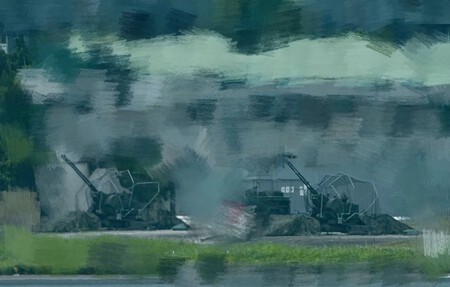
The sight of two anti-aircraft guns wrapped in fishing nets might not scream advanced military technology. Yet, this image encapsulates the profound changes in modern warfare. Taiwan has taken proactive measures to shield its Skyguard systems with anti-drone networks. This need arises from a harsh reality: weapons designed to intercept aerial assaults can quickly fall prey to inexpensive drones if left unprotected.
Countering New Aerial Threats
Traditionally, anti-aircraft systems were created to tackle aircraft, helicopters, and missiles. Now, they must contend with a different enemy entirely: small FPV drones capable of launching direct assaults on radars or cannons from high altitudes. In a potential conflict, Beijing would likely deploy drones not just as attack mechanisms but for reconnaissance, electronic warfare, and to saturate Taiwanese defenses.
Cages covering the cannons
The Irony of Protection
The Swiss Skyguard system, developed during the Cold War, remains essential to Taiwan’s air defense. Its 35 mm cannons, utilizing programmable ammunition like AHEAD, explode before their targets, effectively neutralizing drones and small projectiles. Thus, safeguarding this formidable asset has become crucial; losing a system designed to intercept drones to another drone would be a staggering setback.
Netting as a Defensive Solution
At first glance, the use of fishing nets may look makeshift. However, they serve a defined purpose. An FPV drone must physically hit its target to cause damage. A metal structure covered with nets can divert a drone, causing it to detonate prematurely and preserve the operational status of critical systems.
Lessons from Ukraine
This defensive philosophy resembles tactics used in Ukraine, where military assets—from roads to ships—are also protected with nets and cages to survive against relatively low-cost threats. The Taiwanese military has been training to disperse aircraft across secondary airfields, using civilian disguise tactics for tanks and vehicles to complicate identification.
The Bigger Picture
These nets represent just one component of Taiwan’s comprehensive strategy. The overarching goal is to complicate matters for China. If the People’s Liberation Army can quickly locate and neutralize vital Taiwanese systems, it will significantly hinder the island’s ability to resist an attack.
Redefining Air Defense
Ultimately, the significant takeaway from Taiwan’s implementation of nets over cannons is not simply about physical protection but illustrates that air defense is entering a transformative era. For decades, military advancements focused on developing sophisticated radars and missiles. Now, the challenge is to prevent low-cost drones from exploiting vulnerabilities. The image of a state-of-the-art anti-aircraft system shielded by a simple net poignantly captures the evolving landscape of warfare.
Image | YOUTH DAILY NEWS