
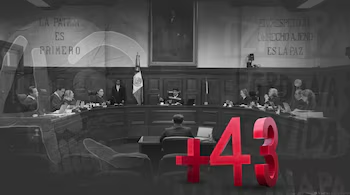
Supreme Court to Review Ayotzinapa Investigation and Truth Commission Ruling
The Supreme Court of Justice of the Nation (SCJN) has chosen to undertake an extraordinary review of a pivotal ruling from 2018 that mandated the formation of the Commission for the Investigation and Truth of the Iguala Case. This development pertains to the long-standing case of the disappearance of 43 students from the Ayotzinapa Rural Normal School, a tragedy that has captivated and galvanized public attention across Mexico.
A New Chapter in the Ayotzinapa Case
This judicial decision marks the onset of a new legal phase in an episode that holds significant emotional and social weight in the country. Numerous civil organizations have expressed trepidation, fearing that this review could further delay the realization of the resolution intended to bring justice. The unanimous decision by the SCJN Full Chamber addresses four extraordinary appeal requests brought forth by federal authorities, exercising their faculty of attraction over the case.
Constitutional Implications
The SCJN will delve into the constitutional ramifications of the 2018 ruling that directed the creation of the investigative commission. The court’s assessment will also consider whether such a directive from a lower court infringes upon essential constitutional principles, including the relativity of judicial sentences and the separation of powers. Various human rights organizations have argued that this renewed review could provoke legal uncertainty and challenge the notion of res judicata, which aims to uphold stability and certainty regarding final judicial decisions.
Background of the 2018 Ruling
The decision made in May 2018 was a watershed moment in the Ayotzinapa case. It mandated a thorough reassessment of the investigation, citing severe irregularities in the initial inquiries and underscoring the need for independent and effective updates, with active involvement from victims’ families. The ruling had promised a pathway toward unveiling the truth behind one of Mexico’s most notorious disappearances.
Appeals and Government Concerns
The extraordinary appeals, initiated under former President Enrique Peña Nieto’s administration, have faced delays since their submission in 2018. Amid heightened scrutiny, the Legal Department of the Presidency requested the SCJN to examine whether legal barriers exist, potentially hindering the establishment of the Truth Commission. This review raises concerns about the Commission’s operational efficacy and the specialized unit’s investigative responsibilities on the case.
Debate Between Justice and Legal Certainty
The SCJN’s decision to revisit the 2018 ruling fuels a complex debate between ensuring legal certainty surrounding judicial resolutions while prioritizing the need for truth and justice for the Ayotzinapa victims. Family representatives of the missing students argue that such extraordinary reviews dilute the finality of judicial decisions, which creates an atmosphere of uncertainty.
Closing Thoughts
As the Supreme Court prepares to review the significant 2018 ruling, its resolution will either reinforce the effects of the initial directive regarding the Truth Commission or potentially reshape the landscape of this high-profile case. With nearly 12 years passing since the students’ disappearance, the situation remains unresolved, and the demand for justice and clarity has never wavered. Stakeholders, including families of the victims and human rights organizations, will be closely monitoring this pivotal judicial process, which continues to bear profound implications for both justice and human rights in Mexico.