
During the day, Shenzhen’s stations look, in some ways, like those of any big city: full of movement, loudspeakers and announcements marking the passage of trains. But when traffic eases, something changes. In the same space where a few hours ago there were crowds, autonomous vehicles and small robots appear that move with precision, transporting packages from one point to another. There is no spectacle or artifice, just a different use of a familiar environment. The metro network, designed for travelers, is also beginning to serve urban logistics at a time when every minute and every square meter counts.
The idea of taking advantage of the subway to move goods does not arise on a whim. In Shenzhen, as in many large Chinese cities, surface traffic has become an obstacle for daily logistics. Delivery companies deal with extreme urban density and the constant growth of e-commerce, which forces them to deliver faster and with increasingly tight margins. Using trains outside of peak hours alleviates this pressure and reduces costs, while at the same time making use of infrastructure that usually remains underused for much of the day.
When Travelers Leave, Robots Stay
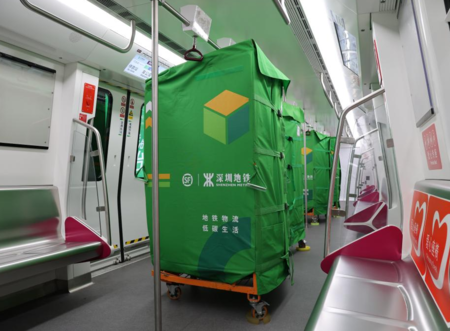
According to the Xinhua agency, one of the officially documented pilots takes place on line 11 of the Shenzhen metro. Every night in Futian District, SF Express staff sort and pack packages, which are then loaded into metal cages. These cages are transported by means of a autonomous shuttle vehicle to the platform, where they are destined for the sixth coach of the train, enabled as a logistics car during off-peak hours. In less than thirty minutes, the goods cross the most congested stretch of the city, arriving at the Bihaiwan area, near the airport, where they continue their journey to the distribution center.
The aforementioned operation is supported by a fleet of robovans. Nikkei Asia explains that these small vehicles are capable of moving autonomously along predetermined routes, transferring packages from a storage center to the subway loading area. Each robovan can transport up to 500 kilos and has a useful space of about 3 cubic meters.
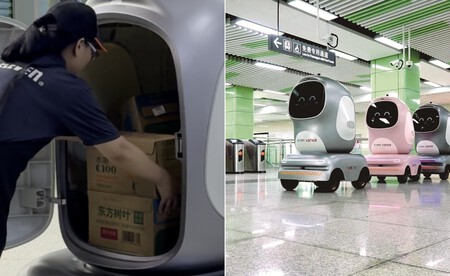
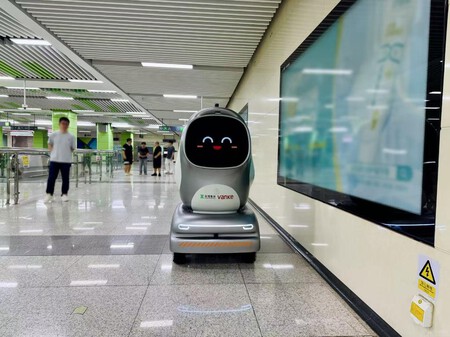
</div>Another official test takes place on subway line 2, at Wanxia station, where delivery robots can board the train by themselves to deliver goods to stores like 7-Eleven inside the station. The system, described by the Guangdong Department of Transportation, combines autonomous route planning, laser sensors, and a control system that allows it to move safely between passengers. This project, promoted by Shenzhen Metro Group, Vanke, and Wanwei Logistics, remains in the testing phase and seeks to assess its scalability within the city’s underground commercial network.
</div>The Chinese industrial ecosystem is one of the key reasons why these types of projects are advancing so rapidly. The aforementioned newspaper highlights that strong competition among national manufacturers has made essential components, such as LiDAR sensors, cheaper and has spurred the development of more efficient batteries and specific chips for autonomous driving. As a result, production costs have significantly reduced. A robovan is already between 20% and 30% cheaper than a traditional commercial vehicle, with even more savings attributed to the elimination of cabin space and the driver’s salary.
</div>However, the development of these initiatives is not without challenges. Autonomous vehicles still depend on human supervision at various stages , especially during the loading and unloading of goods. Their speed inside stations is reduced to ensure passenger safety, which in turn limits operational pace.
<img alt="Tesla promised to have a robotaxi without humans, pedals or steering wheel. His first trips were made with humans, pedals, and a steering wheel." width="375" height="142" src="https://i.blogs.es/931fac/tesla/375_142.jpeg"/>For now, operations remain limited and are far from mass application. Even so, they reflect a clear trend: the attempt to optimize each section of urban space, even the underground. Shenzhen functions as a laboratory for a model that seeks efficiency without altering the rhythm of the city. Ultimately, these tests speak less about technology and more about management : how a metro network can serve two different purposes while remaining, above all, a public service.
Images | Guangdong Department of Transportation (1, 2, 34, 5) | Shenzhen Government (1)
In Xataka | Many Spanish ports have become luxury resorts for the rich: owning a pleasure boat is increasingly difficult.