
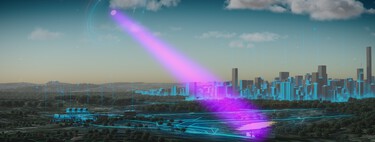
The energy appetite of data centers is nothing new. Elon Musk predicts a shortage of transformers in two years, while Sam Altman believes we will need an energy revolution , such as nuclear fusion, to keep pace with the increasing demand. Challenges are on the horizon as the planet is unprepared for such colossal energy needs. This urgency is the driving force behind Nvidia’s investment in a potential solution: deploying servers outside of Earth.
It’s not science fiction. It is the business model of several startups proposing to build cutting-edge hyperdata centers in Earth’s orbit and even on the Moon. This idea, which once seemed far-fetched, is gaining traction mainly due to two factors: the insatiable demand for AI and the low-cost launches promised by SpaceX’s Starship .
Among the trailblazers in this venture is Starcloud , supported by the NVIDIA Inception program. Their seriousness is underscored by plans to launch Starcloud-1 , its first satellite, in November. This satellite will carry the first GPU for data centers launched into space: an NVIDIA H100 .
The difficult part will come later. Starcloud-1, the size of a small refrigerator, is just the beginning. The company’s ambitious goal is a colossal five-gigawatt orbital data center. Combined with solar panels and an immense radiator, it could measure an astonishing four kilometers wide . The main focus will be training significant AI models in orbit.
Why in space? A comprehensive white paper from Starcloud delineates that future models, like GPT-6 or Llama 5, will require multi-gigawatt clusters—something practically impossible with Earth’s energy infrastructure . In space, limits on energy supply are virtually nonexistent.
Moreover, Starcloud estimates that server energy costs could be 10 times lower in space than on Earth. The proposition of space data centers is firmly rooted in two problems that plague Earth: energy and cooling .
Solar energy 24/7. On Earth, solar energy is intermittent. It is contingent upon the day/night cycle, weather conditions, and atmospheric factors that reduce radiation. In space, however, the scenario is dramatically different. By placing data centers in a sun-synchronous “dawn-dusk” orbit, satellites can follow the line that separates day and night on Earth.
By harnessing solar panels that are illuminated almost continuously, the system can increase its energy capacity to over 95% . Starcloud describes this as “almost unlimited, low-cost renewable energy.”
And the refrigeration? How will they manage the immense heat generated? Earth-based data centers often consume millions of liters of fresh water for cooling. However, in space, water is nonexistent, but there is a more effective solution: an infinite heatsink at -270°C .
The operational plan does not involve ventilating the servers. Instead, they will use liquid cooling systems (direct-to-chip or immersion) to manage GPU-generated heat. Instead of venting hot liquid to evaporation towers, it will be funneled to massive radiator panels.
These panels will then emit waste heat into the vacuum of space in the form of infrared radiation. According to Starcloud’s white paper, calculations using the Stefan-Boltzmann law suggest that a radiator at 20°C can cleanly dissipate over 630 watts per square meter without using a single drop of water.
Not everything that glitters in space is gold. The feasibility of this entire concept hinges on the successful launch of high-capacity, reusable rockets like SpaceX’s Starship . Starcloud’s projections are built on a long-term launch cost of $30 per kilogram put into orbit. Yet, Starship is still in its developmental stage and is far from achieving full rapid reusability. If these costs do not materialize, the economic viability of the system is at risk.
Another substantial concern is radiation . Commercial GPUs are not designed to withstand the harshness of space. Cosmic radiation and solar flares pose significant risks that could damage electronics. The solution involves adding protective armor, which increases weight and subsequently the launch costs. Furthermore, current technology makes maintenance virtually impossible.
Image | Starcloud
In Xataka | Space solar never worked. A military escalation in orbit is making it a reality.