
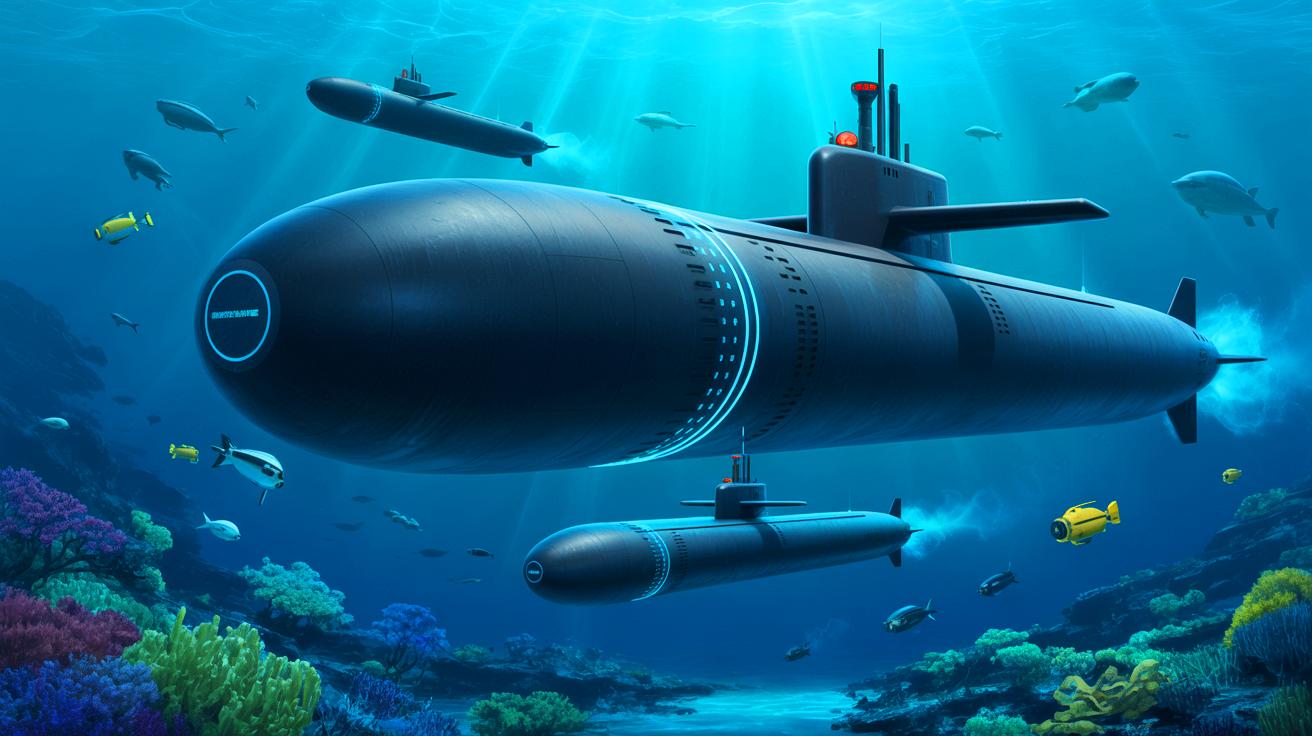
Revolutionary Advances in Underwater Communication Technology
In recent years, underwater communication has seen remarkable advancements, primarily driven by the relentless efforts of researchers at the Northwest Polytechnic University in China. The development of a new underwater communication technology is set to redefine data transmission over long distances, with implications in both civil and military sectors. This article delves into these significant developments, their benefits, challenges, and future applications.
Overcoming Data Integrity Challenges in Underwater Environments
Transmitting data accurately over long distances underwater presents numerous technical obstacles. In certain military applications, even the slightest data corruption can have severe consequences. Critical operations, such as activating dormant underwater drones or coordinating precise attacks, necessitate complete data integrity. However, the underwater environment complicates these tasks. Sound waves can easily disperse into confusing echoes, and moving sources can cause Doppler shifts. Furthermore, background noise can easily drown out weak transmissions.
To tackle these challenges, Professor He Chengbing and his team have developed an auto-adjustable system. This groundbreaking mechanism can identify signal groupings in noisy underwater environments, requiring no prior knowledge of the seabed topography. They have also devised an innovative algorithm capable of transforming turbulent and variable channels into quasi-static acoustic snapshots, facilitating iterative error correction. However, this cutting-edge technology demands considerable computational power, making real-time applications on small drones a daunting challenge.
Promising Results from China’s Hydrophone Array
In 2021, tests conducted at a classified offshore site demonstrated the ability to transmit acoustic data without error over distances of 202 miles (approximately 370 kilometers). Utilizing an eight-element hydrophone array attached to a buoy and QPSK coded signals, the system achieved a data transmission rate of 37.5 bits per second during long-distance trials. These experiments confirmed the method’s efficacy for error-free underwater acoustic communication over vast distances.
According to the journal Acta Acustica, the sound source used during the offshore tests operated at an astounding 176 decibels. This low-frequency range is particularly well-suited for long-distance underwater communication, as lower frequencies can travel further with less attenuation. The Northwest Polytechnic University, recognized as one of China’s "Seven Sons of National Defense," has played a pivotal role in this technological advancement, undeterred by ongoing sanctions and cyberattacks from the United States.
Northwest Polytechnic University: A Key Player in Acoustic Research
Since establishing its underwater acoustics department in the 1950s, Northwest Polytechnic University has trained graduates who have significantly contributed to developing China’s most advanced warships and marine surveillance networks. This institution remains at the forefront of research in underwater acoustics, continuing to push the boundaries of communication technologies crucial for national security and technological advancement.
Researchers at this esteemed university tirelessly work to innovate in the field of underwater communication. This commitment to excellence and scientific achievement has enabled China to achieve significant advancements in this strategic domain.
Future Implications of Error-Free Acoustic Communication
The ability to transmit acoustic data without error over long distances opens exciting avenues for future applications. In the civil sector, this technology could revolutionize how data is transmitted for oceanographic studies and search-and-rescue operations. In the military realm, it promises to significantly enhance the coordination and communication of underwater forces.
Despite these advancements, several hurdles remain, particularly in adapting this technology for practical and real-time use. The challenges of optimizing computational power and managing disturbances caused by storms or sudden maneuvers are obstacles that need to be overcome. How these innovations will influence future submarine communication strategies remains an open question and a topic of significant interest.
In conclusion, the innovations stemming from the research at Northwest Polytechnic University signify not just technical milestones but also open new strategic pathways in various sectors. As our capabilities grow, they will invariably shape the future of underwater communication, ensuring its vital role in both civilian and military contexts.
| IN BRIEF |
|
Technological advancements in underwater communication have reached a pivotal moment, thanks to Chinese researchers. With a recent innovation, it is now possible to transmit acoustic data over long distances without any errors. This technology, developed by Northwest Polytechnic University in China, could transform civil and military underwater communication applications. This article explores the implications of this breakthrough and the associated technical challenges.