
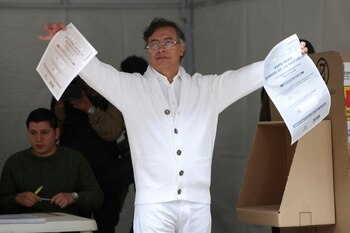
Historical Victory for the Historical Pact
In the wake of the 2026 legislative elections, President Gustavo Petro has proclaimed a significant triumph for the Historical Pact, establishing it as Colombia’s foremost political force. However, while the results are promising, Petro acknowledged that his coalition fell short of achieving an outright majority, underscoring the necessity for political alliances to propel his government’s social reforms.
Emphasis on Health Reform
Utilizing social media, Petro reaffirmed that a key focus on his legislative agenda will be the revival of health reform discussions, recognized as one of his administration’s most contentious initiatives. “Only in the pre-count and in the absence of scrutiny is there any doubt that the Pact swept the Congressional elections,” he expressed.
Nevertheless, he cautioned that this does not equate to total legislative dominance. Emphasizing collaboration, he stated, “The idea of a great Alliance for Life and prosperity must be maintained,” urging newly elected congressmen to bolster political education and avoid previous pitfalls plaguing Colombian politics.
Senate Composition and Future Challenges
Preliminary results suggest that the Historical Pact is projected to secure between 25 to 26 Senate seats, making it the party with the highest representation in the upper house. Of these, 25 seats stem from the movement’s open list, translating to approximately 4.4 million votes. This electoral success marks a significant growth from their 2022 performance, where they secured nearly 2.8 million votes.
Shifts in the Political Landscape
The recent elections have illustrated a notable shift in Colombia’s political terrain. The left coalition notably managed to win in 12 out of 32 departments, with essential victories in regions like Bogotá and Valle del Cauca. This outcome not only strengthens the ruling party’s position in Congress but also lays the groundwork for more solid presidential campaigns aligned with similar political ideologies.
High Voter Turnout and Legislative Evolution
This election cycle saw unprecedented participation, with over 21 million Colombians casting their votes—representing the highest turnout since 1990. This surge underscores the electorate’s engagement and reflects the populace’s desire for change.
Despite the Historical Pact emerging as the largest faction, the Senate’s new composition suggests a fragmented scenario where no party can impose its agenda without negotiation. Political projections indicate the Democratic Center could secure about 17 seats, while the Liberal Party may claim around 13. This environment will necessitate collaboration among various political entities, including the liberals, conservatives, and the U Party, to formulate effective legislative strategies.
Looking Ahead
As the newly elected Senate is set to convene on July 20, the agenda will likely prioritize social reforms, potential discussions for a constituent assembly, and the appointment of future Constitutional Court magistrates. The country watches closely as final scrutiny results are awaited to determine the ultimate distribution of seats.