
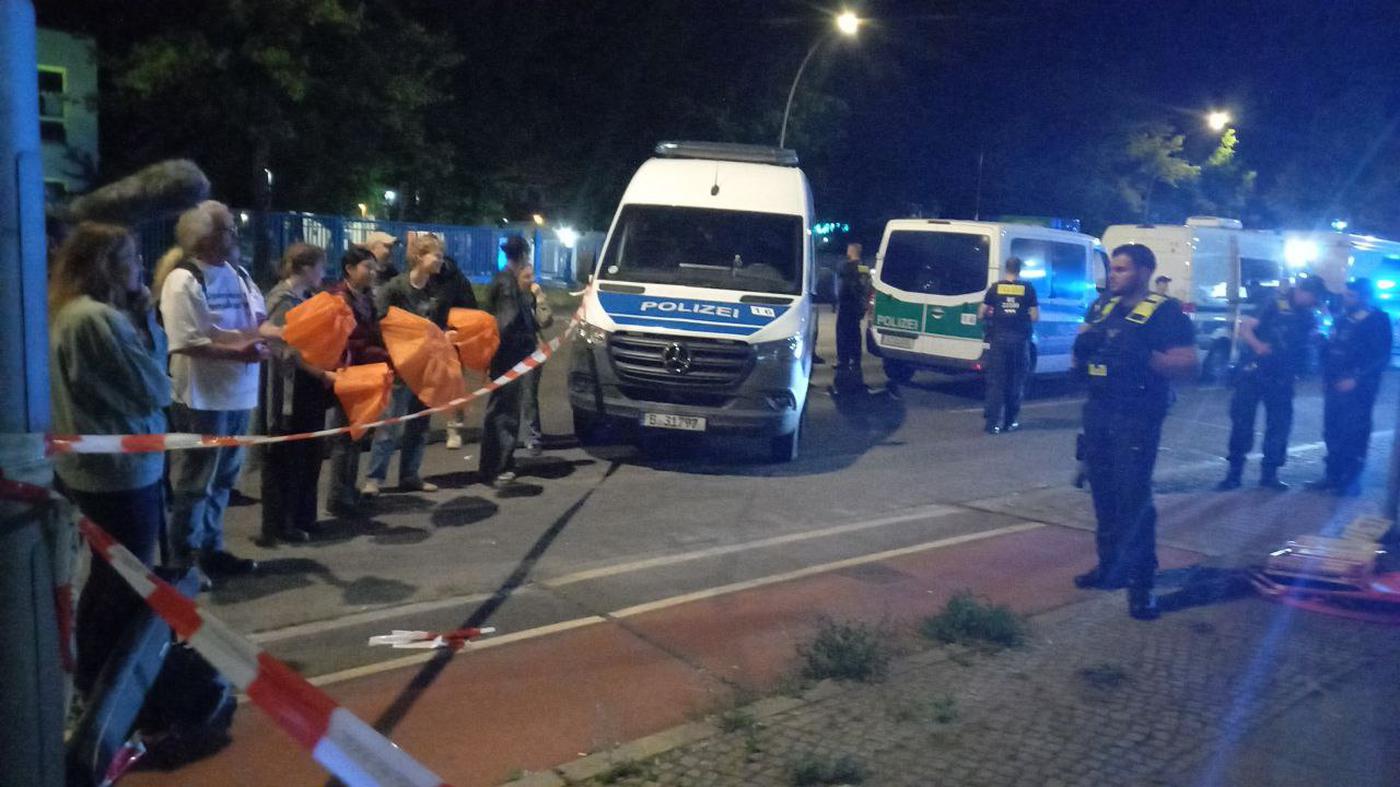
Police Intervenes in Protest by “New Generation” in Berlin-Spandau
On a late Sunday evening, the Berlin police successfully thwarted a blockade attempt organized by the group known as “New Generation” in front of the Axel Springer printing house in Berlin-Spandau. According to a police statement, 39 activists were temporarily detained during the incident. Of these, 34 individuals were placed in police custody until Monday morning, at which point they were all released.
The “New Generation” is a successor to the climate protection group “Last Generation.” Reports indicate that a rental van arrived at the primary entrance of the printing facility on Brunsbüttler Damm around 10:10 PM. Nearly 40 activists allegedly jumped off the cargo area of the vehicle, with additional activists joining from surrounding streets. They aimed to lock and block the gates of the printing house, reportedly using the rental vehicle as part of their strategy. One activist even jumped onto the hood of an approaching civil vehicle.
A Bold Objective: Stopping Press Deliveries
The self-declared goal of the New Generation was to prevent the timely delivery of several publications from the Springer publishing house , particularly Bild and B.Z. The police countered this protest with both civilian and uniformed officers, employing techniques such as pushing, pressing, and using restrained shock methods to deter the protestors from establishing a sit-in or gluing themselves to objects.
Witnessing the police’s tactics, the activists accused officers of using brutal force, claiming they were “sometimes violently thrown to the ground.” The clash created a tense atmosphere as both sides grappled with the nuances of protest versus law enforcement duty.
Police Discover Evidence of Intent
In a key moment during the standoff, two activists attempted to drive the rental van away from the scene, only to be thwarted by police. Officers subsequently discovered various items inside the vehicle, including a wheel lock to block tires, containers of glue, seat foam mats, spray paint cans, and thematic T-shirts.
Overall, the police recorded 39 charges of coercion and five counts of resistance against police officers. The operation involved around 80 police officers , and inquiries made to Springer for comments on the incident went unanswered.
Eclectic Responses and Accusations
The Berlin police also raised accusations against some journalists present at the scene, alleging they obstructed law enforcement’s efforts. One journalist found himself temporarily detained as officers struggled to differentiate between activism and journalism at that moment. The journalist was released upon verification of his profession.
An Evolving Motive: From Climate Activism to Anti-Fascism
This action marks a significant shift in the organization’s approach. Rather than focusing solely on climate issues, the activists under their new name have taken an anti-fascist stance . On the same day, they carried out a gluing action at the German Historical Museum , also aimed at promoting this new agenda.
The New Generation articulated their beliefs by claiming that Springer operates ” politics for the rich and right-wing ” under the guise of journalism. They decried Bild as not merely a newspaper but as ” an instrument of power for autocrats and fascists. ” However, the group failed to provide clarity regarding who they specifically identified as autocrats and fascists.
In the Context of Broader Activism
Recent developments in Berlin have seen a proliferation of activism, with groups like the Widerstands-Kollektiv —another spinoff from the Last Generation —also making headlines with their protests. It is evident that this new configuration of activists is increasingly willing to challenge not just environmental issues but broader societal norms and political structures.
As Berlin continues to navigate complex tensions surrounding activism, police enforcement, and journalistic integrity, it becomes crucial for all parties involved to engage in constructive dialogue. The actions taken over the weekend highlight both the determination of the protestors and the rigorous response from law enforcement, encapsulating a microcosm of the larger societal debates at play.