
A New Era of Lunar Exploration: Artemis II Launch Date Announced
Since the historic Apollo 17 mission, no human has ventured into lunar orbit. With more than 50 years elapsed since that momentous journey, NASA’s Artemis program aims to reinstate human presence around the Moon. Despite facing numerous delays and technical setbacks, including a recent issue with the rocket’s helium system, NASA has announced a new target date for its manned mission, Artemis II.
The Date
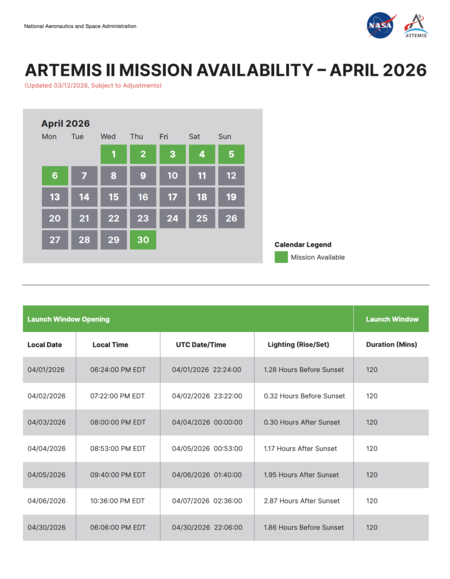
NASA is setting its sights on April 1, 2026, for the first launch opportunity of Artemis II. The mission’s initial launch attempt is slated for 6:24 p.m. Eastern Time (U.S.), which translates to 12:24 a.m. on April 2 in mainland Spain. This timeline comes in the wake of repairs completed on the rocket’s helium system, crucial for maintaining fuel tank pressure. The previous malfunction necessitated the rocket’s removal from its launch platform to replace a malfunctioning seal.
Artemis II launch window schedule for April 2026
How Launch Windows Work
In the realm of space exploration, flexibility is key. Launch windows are not fixed dates but rather timeframes in which the rocket can launch along a trajectory that meets mission objectives. These windows are determined by precise orbital calculations that account for Earth’s position, the destination, and the energy required for the journey. If the rocket cannot launch within this timeframe, the mission must be rescheduled for the next available window.
Are Launch Dates Guaranteed?
While NASA has established a tentative schedule, the success of each launch window hinges on multiple last-minute factors. Teams at the assembly building and Kennedy Space Center are diligently working to ensure everything is in place. Lori Glaze, the acting associate administrator of the Exploration Systems Mission Directorate, emphasized that the final go-ahead depends on hardware readiness and environmental conditions. Launch attempts cannot proceed in the face of adverse weather, such as lightning or strong winds.
Preparing for Launch: Ground Travel
The Space Launch System (SLS) rocket must first return to the Kennedy Space Center launch pad from the assembly facility. After its arrival, extensive preparations and reviews will take place to ensure all systems are ready. This meticulous process involves continuous coordination among various teams and systems, making it challenging to schedule consecutive launch attempts. Glaze noted that during the first six days of April, there could be as many as four viable launch opportunities.
The Significance of Artemis II
When Artemis II launches, it will mark the first time a human crew has orbited the Moon since 1972. The mission will include American astronauts Reid Wiseman, Victor Glover, and Christina Koch, along with Canadian astronaut Jeremy Hansen. Over a ten-day mission, the Orion spacecraft will traverse around the far side of the Moon, an area not visible from Earth. This journey will serve as a vital test of mission systems, paving the way for future Artemis missions aimed at landing astronauts on the lunar surface.
Conclusion
With Artemis II, NASA is reigniting humanity’s journey toward lunar exploration. As the date approaches, anticipation builds not just for a return to the Moon but for the long-term aspirations of establishing a sustainable human presence there. The Artemis program continues to push boundaries, showcasing the resilience and ingenuity of space exploration.