
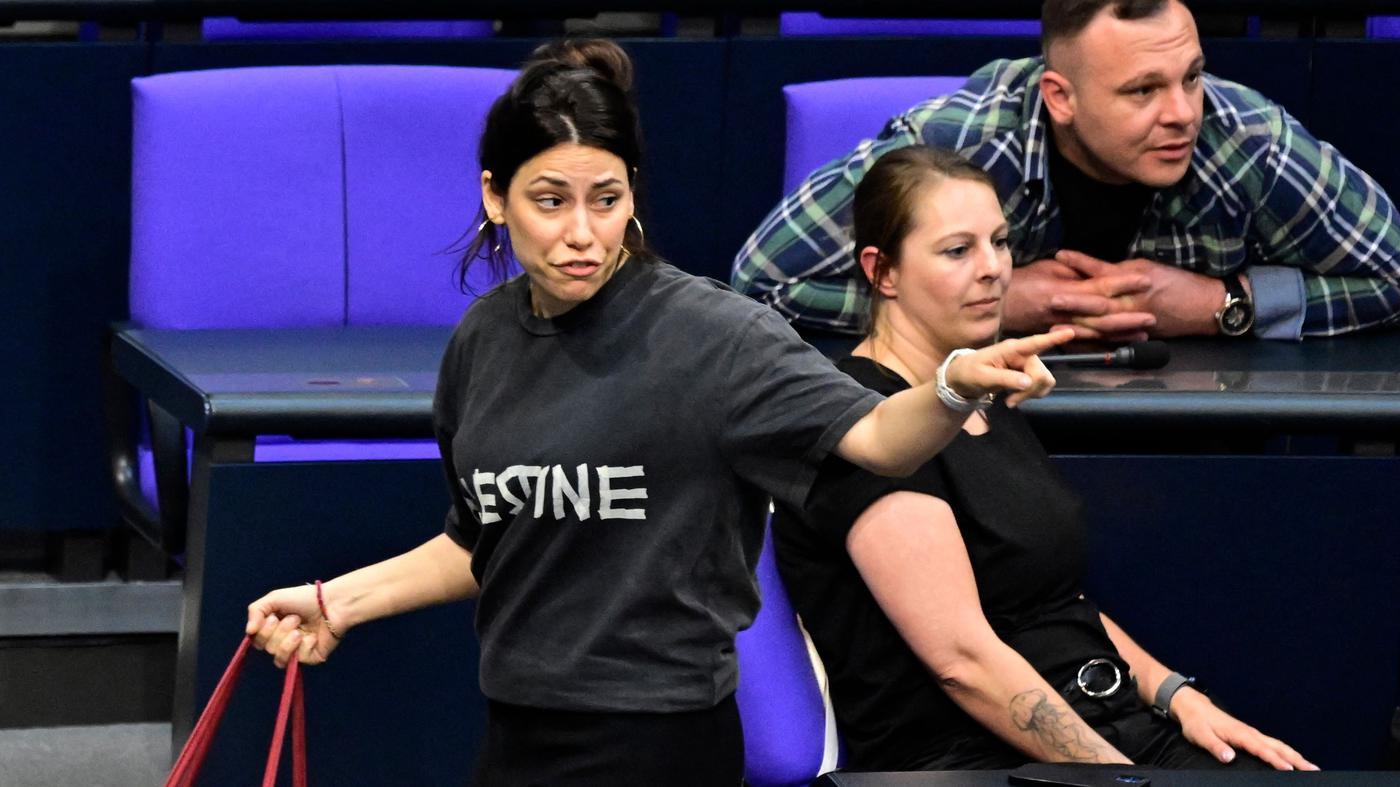
Controversy Erupts in Bundestag Over Political Apparel
In a highly controversial event in the German Bundestag, President Julia Klöckner (CDU) abruptly interrupted a session on Wednesday to expel Cansin Köktürk, a politician from the Left party. The incident occurred when Köktürk wore a T-shirt emblazoned with the word "Palestine" during a government questioning session. This has reignited discussions about the appropriateness of political symbols in parliamentary settings.
Initial Incident and Expulsion
Klöckner addressed the Bundestag, stating, "I want to make a comment here," emphasizing that there’s a clear rule prohibiting political statements on clothing within the parliamentary chamber. Following her request for Köktürk to change her attire went unheeded, Klöckner firmly stated, "I would ask you to leave the session, please,” leading to Köktürk’s exit from the room. Eyewitness accounts described a chaotic atmosphere as other members of parliament spoke over one another, compelling Klöckner to call for order and remind representatives that discussions should take place either from the podium or outside the chamber.
Köktürk’s Past Demonstrations
This was not the first time Köktürk has faced scrutiny for her choice of attire. Earlier this April, during the Bundestag’s inaugural session, she donned a kufiya, a traditional Palestinian scarf. This act prompted members of the CDU to demand a ban on such apparel in parliament, noting its association with resistance against Israel.
In a letter signed by Johannes Volkmann, Daniela Ludwig, and Pascal Reddig, they articulated concerns that the kufiya is viewed as a symbol of resistance, often associated with terrorism and antisemitic rhetoric.
Statements from Klöckner
In her remarks, Klöckner reiterated the importance of maintaining decorum in the Bundestag. She emphasized that political discourse should be conducted solely through words, stating, "In the plenary session of the German Bundestag, political discussions are conducted through speech and exclusively through speech." Any expressions of political sentiment through banners, leaflets, or articles of clothing are deemed unacceptable. She urged all legislators to respect this longstanding tradition, which has been a guiding principle for 75 years.
As the newly elected President, Klöckner highlighted the significance of adherence to these rules. "We must ensure compliance in this legislative period," she affirmed.
Reaction from Köktürk and Allies
Köktürk responded to her expulsion shortly after on the platform X, referencing an earlier statement made by Foreign Minister Johann Wadephul (CDU). She contended that her choice of clothing is a statement against the human rights violations perpetrated by the Israeli government, citing support from international bodies such as the International Court of Justice, the International Criminal Court, and numerous reputable human rights organizations.
Claiming that she wore the kufiya to draw attention to these matters, Köktürk clarified that "wearing the kufiya and solidarity with Palestine should not be equated with supporting the terrorist organization Hamas." The kufiya is, in her view, a symbol of solidarity, not hate.
Broader Context
The incident shines a light on the deeply entrenched and often polarizing views regarding the Israeli-Palestinian conflict in Germany. The Left party’s relationship with Palestine has been a point of contention within German politics for years, facing accusations of antisemitism. Many within the Union party have accused the Left of failing to disassociate from extremist elements.
In recent weeks, other notable instances of politically charged expressions in parliament have arisen, such as Marcel Bauer of the Left party being removed for wearing a beret, further illustrating the contentious climate surrounding political apparel.
The ongoing debates surrounding symbolism in politics extend beyond this incident, becoming emblematic of the larger societal discourse about political expression and representation in Germany. Political analysts predict this will not be the last such occurrence in the Bundestag, as tensions regarding identity and political expression continue to escalate.
The overarching question remains: to what extent should political symbols, whether supportive of Palestine or any other political message, be allowed in official governmental settings? This controversy invites broader reflection on the intersection of free expression, political identity, and institutional decorum.
Ultimately, the debate isn’t merely about a shirt or a scarf; it encapsulates the ongoing struggle over how political expression is perceived and regulated within the hallowed halls of democracy.