
Shenzhen’s Dramatic Transition
Shenzhen, once a quaint fishing village, has dramatically evolved into the world’s leading technological hub. Although the notion of it being merely a fishing village is an exaggeration—boasting a population of 330,000 in the late 70s—its current status is nothing short of extraordinary. Today, over 17 million residents call Shenzhen home, and the city is synonymous with tech giants like Huawei, Tencent, DJI, and BYD.
The Evolution of Shenzhen’s Subway
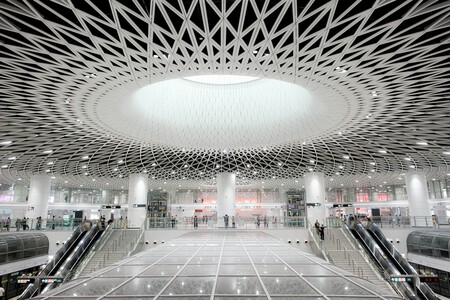
With Shenzhen’s rapid urbanization, the city’s transport network has adapted alongside its burgeoning skyline. The Shenzhen subway system is notable not just for its extensive coverage but also for its ambitious design. While Western metro systems often prioritize functional designs within budget constraints, Shenzhen presents aesthetically pleasing stations that feel like they belong in a science fiction movie.
Current Structure of the Subway System
Today, the Shenzhen subway network stretches over 635 kilometers, with 441 stations across 17 operational lines. It leads the nation in network density, offering around 15,000 trips per kilometer per day. Among its features are semi-automatic and fully automated lines, such as the cutting-edge Line 20 and the incredibly fast Line 11, which boasts speeds of 120 km/h.
Unique Operational Model
Interestingly, the Shenzhen metro network operates under two different companies: Shenzhen Metro Group, which oversees the majority of lines, and the MTR Corporation of Hong Kong, which manages Lines 4 and 13. This arrangement adds complexity to operations but also presents opportunities for innovation.
Why Shenzhen’s Subway Stands Out
The Shenzhen metro exemplifies how speed of execution and high-quality design can coexist. Remarkably, the construction costs in China average around $250 million per kilometer, significantly lower compared to major Western cities like Paris or New York, where costs can be two to eight times higher.
Catalyzing Urban Development
The design and planning are guided by a Transit-Oriented Development (TOD) model that promotes urban growth around transport stations. Thus, the metro not only serves commuters but also integrates urban development, making it a global reference for modern transportation networks.
The Eye of Shenzhen, emblematic of Gangxia North Station. (Image Credit: Michael Held)
Historical Context
In the late 1970s, Shenzhen’s growth trajectory was spurred by its designation as a Special Economic Zone, aimed at boosting economic development. Metro planning began in the 1980s, with construction kicking off in 1998 and the first line opening on December 28, 2004. This first line was modest, featuring just 17.4 kilometers and 15 stations.
Factors Behind Rapid Development
Building an astounding 30 kilometers per year is a feat scarcely achievable in European cities. The secret? Large-scale prefabrication allows for components to be built in factories and assembled on site. Additionally, meticulous planning from design through to maintenance ensures each station is a showcase of Shenzhen’s identity.
Innovative Business Model
The “Rail + Property” model, popularized in Hong Kong, has allowed Shenzhen’s metro network to flourish without waiting for lengthy state budgets. This model enables the operator to develop land around subway stations, creating residential and commercial spaces that fund railway investments.
Future Aspirations
Shenzhen’s metro is set to expand further, reaching 831 kilometers by 2028 with nine new lines currently under construction. By 2030-2035, the goal is to exceed 1,000 kilometers, aiming for seamless connections between Shenzhen and the major cities in the Greater Bay Area.
Anticipating Future Challenges
However, a rapidly expanding network poses challenges, particularly in terms of maintenance and interoperability among diverse systems. As Shenzhen continues to grow, strategic planning will be crucial to manage its burgeoning infrastructure effectively.