
Is Polluting Profitable? Understanding the Economic Landscape of CO2 Emissions
The Current State of Emissions Goals
As the globe convenes for COP30 discussions in Belém, Brazil, the European Parliament has finally agreed to a substantial reduction target: a 90% cut in greenhouse gas emissions by 2040. However, the reluctance to solidify this commitment until the last moment indicates a troubling stagnation in the fight against climate change.
The Role of Carbon Capture Technology
A critical strategy that Europe is looking to leverage is Carbon Capture, Use, and Storage (CCUS). This technology aims to capture, store, and occasionally reuse CO2 emissions generated by industrial activities. While Brussels is heavily investing in CCUS, skepticism exists within the environmental community, fearing it may become a convenient excuse for continued pollution rather than a genuine corrective measure.
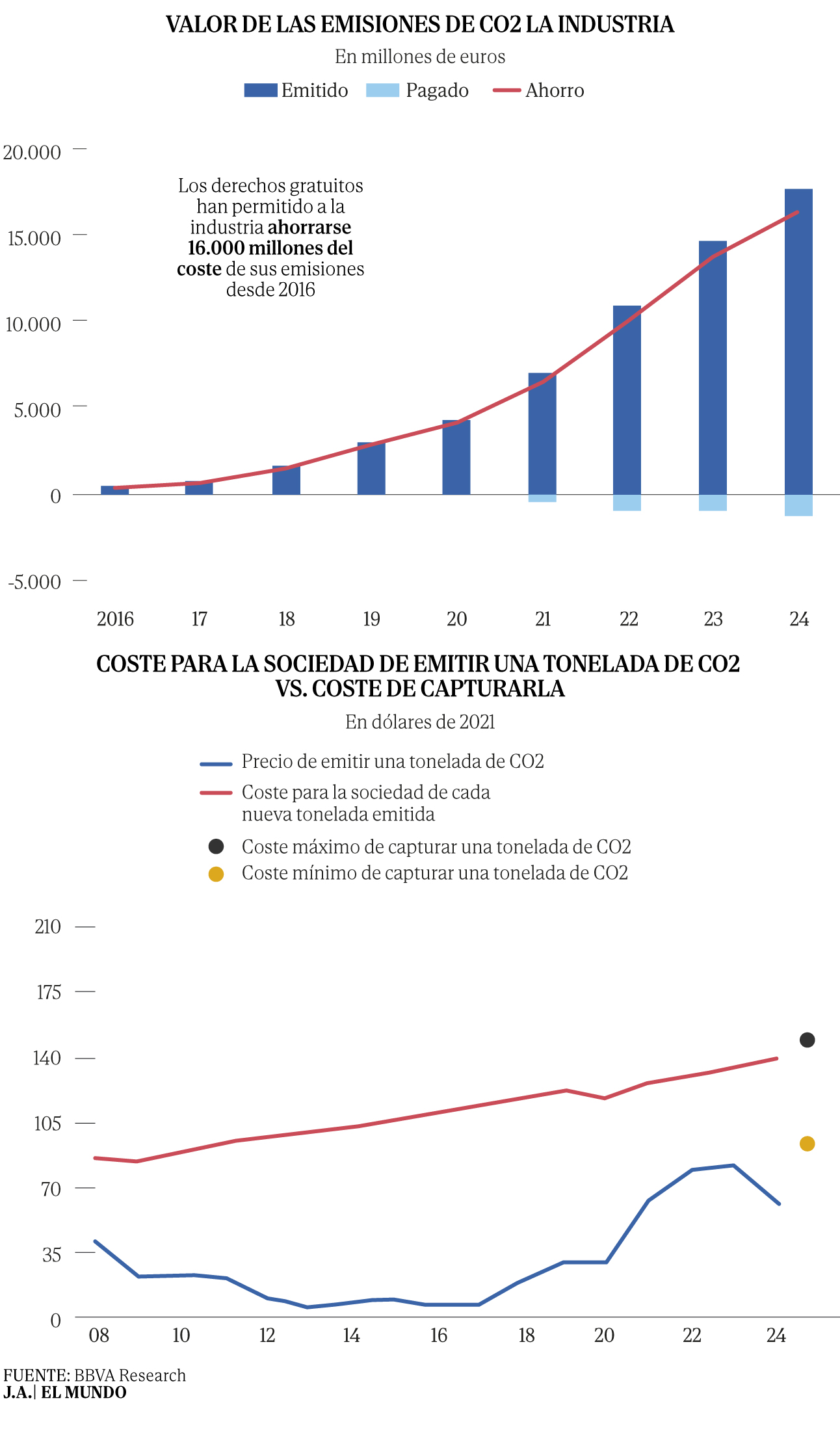
Despite being a hopeful solution, the reality in Europe is stark: capturing CO2 remains significantly more expensive than emitting it. According to a report by BBVA Research, the costs of capturing a ton of CO2 range between €100 and €200, while the cost of emitting it can be as low as €60 under the European Trading System (ETS).
The Economics of Emission and Capture
This economic disparity creates a challenging landscape for companies. The financial gap leaves industries, especially high emitters like cement and metallurgy, hesitant to invest in capture technology. The low price of emissions means that many companies deem it economically logical to continue polluting.
Investment Gaps and Free Emission Rights
The situation is made worse by structural factors in the European market. For years, many European industries have benefited from free emission rights aimed at preventing carbon leakage—essentially encouraging companies to stay in the EU by reducing their climate-related costs. A report highlighted that from 2016 to 2024, the Spanish industry produced emissions worth €17.5 billion, but contributed less than €1.3 billion due to these free rights. This system allowed companies to save over €16.2 billion.
While the EU is phasing out this model, the transition has faced delays, as seen with the postponement of ETS2, which will eventually impose costs on sectors previously exempt, like transportation.
The Future of Carbon Pricing
Experts believe that the gap between the costs of emission and capture is steadily narrowing. Julian Cubero, chief economist at BBVA Research, emphasizes that by 2026, the pressure for companies to adopt carbon capture technologies will heighten significantly as they begin paying more for emissions licenses. Similarly, Charles Kirby from EY Consulting warns that relying on free rights and low carbon prices is becoming increasingly untenable.
Roadblocks to Implementation
A considerable concern for Spain, compared to other European nations, is the lack of a specific roadmap for carbon capture. Policies vague on CCUS limit the momentum for projects that typically require 8 to 10 years of development. Additionally, various structural challenges exist, such as geological risks perceived in CO2 storage and the ongoing reliance on fossil fuels.
Conclusion: A Step Towards Decarbonization
Both Cubero and Kirby assert that CCUS should be viewed as part of a comprehensive decarbonization strategy—a tool to facilitate the transition toward fully sustainable systems rather than an excuse for continued fossil fuel dependence.
As this situation unfolds, understanding the intricacies of carbon capture economics will be vital. The more concentrated the CO2, the easier it generally is to capture. However, extracting CO2 directly from the atmosphere remains prohibitively expensive, prompting companies to carefully analyze the technology’s fit within their industrial processes.
As economies grapple with these evolving challenges, one crucial question remains: when will we place more value on decontaminating than on contaminating?