
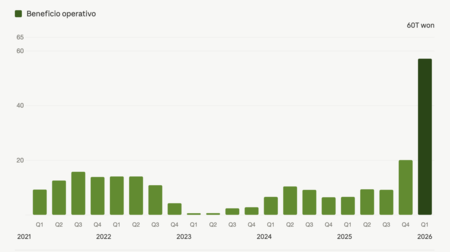
Samsung, a brand that seamlessly integrates into our daily lives, has made headlines recently with its remarkable financial surge. While many sectors grapple with rising costs and unstable markets, Samsung’s performance in early 2026 has shattered expectations, leaving industry observers both surprised and impressed.
The Financial Breakthrough: A Closer Look
According to estimates from the Korean giant, Samsung is poised to report an astonishing operating profit of approximately 57.2 trillion won ($37.9 billion) for Q1 2026. To put this in perspective, this profit eclipses the entire 2025 figure of 43.6 trillion won. Essentially, Samsung has generated more profit within just three months than it did over the entire previous year, alongside a projected revenue increase nearing 70% year-on-year.
Understanding Operating Profit
Operating profit serves as an essential metric for assessing a company’s core business performance, as it omits the complexities of taxes, interest, and other financial adjustments. As Samsung prepares to release its comprehensive results on April 30, these preliminary figures indicate an impressive turnaround for the company.
The Shift in Technology Demand
One of the key factors in this financial leap is Samsung’s significant role as a memory chip manufacturer. While many consumers associate Samsung with phones, televisions, and home appliances, a large portion of the company’s memory production is directed to data centers and servers, which are instrumental in powering AI services. This often-overlooked aspect of Samsung’s business has become increasingly vital during the current tech revolution.
Limited Production Capacity and Market Dynamics
The technology industry is currently facing limitations in production capacity, a sentiment echoed by Micron’s insights. With manufacturers strained to scale production rapidly, many are pivoting their resources towards advanced memory solutions, particularly High Bandwidth Memory (HBM). This shift not only enhances profitability for chip manufacturers but also escalates demand.
However, as production focuses on advanced memory, DRAM—widely used in consumer electronics—faces supply shortages. Recent data from Citigroup notes an impressive 64% rise in its global average price during Q1, a situation that undeniably complicates the cost structures for manufacturers of mobile phones and computers.
The Bigger Picture: South Korea’s Semiconductor Authority
Samsung’s performance also places it at the forefront of South Korea’s semiconductor industry, a vital component of the nation’s economy. Competing against giants like SK Hynix and Micron, Samsung’s strategic decisions can significantly influence global memory availability and pricing.
The Role of AI in Shaping Demand
The surge in demand for AI has led to an increased need for specific infrastructures, dominated by products like NVIDIA’s chips. However, these systems cannot function efficiently without substantial memory, which is where Samsung’s offerings come into play. Though Samsung may not receive the same spotlight as NVIDIA, it benefits from the downstream demand generated by this AI boom.
In essence, Samsung’s recent financial success underscores the intersection of evolving technology demands and corporate strategy, highlighting a compelling narrative for stakeholders in the tech industry.