

The Fujian: A New Era for China’s Aircraft Carriers
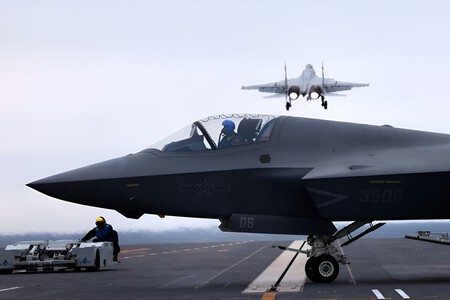
In mid-September, a tense scene unfolded in China as the nation showcased its latest technological achievement—the Fujian , its new aircraft carrier. The stakes were high for the People’s Liberation Army Navy (PLAN), as this vessel was set to revolutionize naval aviation through its innovative electromagnetic catapult system, moving away from the traditional steam-based launch systems that have dominated for decades.
As the eyes of the world turned toward Beijing, U.S. defense analysts took note of the implications.
Structural Limitations of the Fujian
The initial excitement surrounding the Fujian’s capabilities faced skepticism. Two retired U.S. Navy officers analyzed images of the new carrier and concluded that its deck configuration poses significant operational challenges. According to their findings, takeoffs and landings on the Fujian are forced to be sequenced rather than overlapped, likening its operational rhythm to only about 60% of that of a Nimitz-class carrier , which has been operational for over half a century.
Understanding the Operational Drawbacks
The disparity in design is significant. The launch angle of the Fujian’s catapults and the overall landing area length create what analysts describe as kinetic conflict points . Essentially, aircraft repositioning after landing can obstruct the launch catapults, consequently slowing down the recovery of aircraft. Given the high-paced environment of naval warfare, this risk of collisions necessitates a reduction in the tempo of operations, diminishing the carrier’s potential output generation capabilities.
A Technological Leap Forward?
Despite these limitations, the Fujian’s electromagnetic catapults mark a significant advancement. This system allows for the launch of heavier aircraft loaded with more weapons and fuel, increasing their operational range and effectiveness. The only other U.S. carrier featuring this technology is the USS Gerald R. Ford , which makes the Fujian a revolutionary shift from its predecessors, the Liaoning and Shandong, which use conventional ski jumps.
However, transitioning from hardware breakthroughs to operational effectiveness is challenging. The operational culture aboard an aircraft carrier—such as the intricate dance of cycles, sequences, and the discipline of personnel and machinery under pressure—requires years to develop. Veterans emphasize that without this accumulated experience, the advanced capabilities of the Fujian may remain untapped, ultimately leading to reduced pacing and increased operational risks.
China’s Growing Naval Power
China is rapidly expanding its naval capabilities; the Fujian is just one example of this growth. Despite launching ships at an impressive rate, it faces a generational gap in aircraft carriers: eleven in total compared to just two operational U.S. carriers. This disparity in experience, with U.S. carriers enjoying decades of operational know-how, places the Fujian at a disadvantage.
While the Fujian aims to compete with the Nimitz-class carriers, experts note that its design limits operational tempo. Meanwhile, the U.S. Navy operates ten Nimitz carriers with matured operational doctrines.
Future Generations and Learning Curve
Officials interpret the Fujian as an intermediate platform designed to iterate on its capabilities in future models. The subsequent carrier, identified tentatively as the Type 004 , may correct existing design challenges to maximize the potential of the Fujian.
This learning pattern is evident in China’s industrial approach: fail, learn, and iterate. Thus, while the Fujian may not be the pinnacle of naval technology yet, it serves a critical educational role for the PLAN.
Shifting from Steam to Electricity
Historically, steam catapults have been the backbone of naval aviation since the 1950s, utilizing steam pressure to launch aircraft. They are large and energy-inefficient, with demanding maintenance needs. The transition to Electro-Magnetic Aircraft Launch System (EMALS) represents a significant leap forward, allowing for digitally controlled acceleration—reducing wear on aircraft and enabling quicker recovery times between launches.
However, this technological advantage is conditional. To realize its full potential, the Fujian requires a robust deck architecture , well-defined operational doctrine, and disciplined sequence operations—all of which take time to develop.

Time as a Crucial Factor
Ultimately, analysts argue that the real challenge facing the Fujian isn’t solely technological but involves mastering the complexities of naval aviation. It is not just about engineering innovation, but about years of operational experience to effectively capitalize on those advancements.
In conclusion, the true combat power of an aircraft carrier lies not merely in its tonnage or technological sophistication, but in its ability to execute swift and efficient operations under extreme conditions, built upon years of trust and operational mastery. Time will tell if the Fujian can bridge the gap and transform its physical capabilities into sustained operational power.