
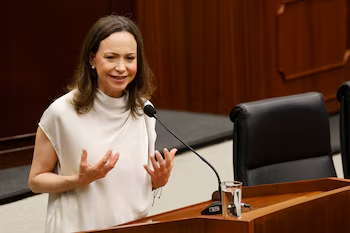
María Corina Machado Declines Dialogue with Chavismo but Remains Open to Progress
Venezuelan opposition leader and Nobel Peace Prize winner, María Corina Machado, has made headlines with her recent declaration that she will not participate in the new dialogue mechanism announced between Chavismo and members of the National Assembly elected in 2015. Despite her absence from these discussions, she emphasized that this decision will not become an obstacle to initiatives promoting a political transition in Venezuela.
Context of the Non-Participation
In a joint statement with fellow opposition leader Edmundo González Urrutia, Machado expressed concerns that the dialogue process lacks inclusivity, highlighting that it was formulated without their input. She stated, “It is not up to us to explain its scope or its decisions,” urging promoters of the initiative to clarify its objectives, methodology, and timeline to the public.
Despite her reluctance to engage in the dialogue, Machado clarified that she evaluated any proposal based strictly on concrete results. In her remarks, she underscored essential issues that need addressing: the recovery of democratic institutions, the release of political prisoners, protections for political actors, a call for presidential elections, and respect for electoral sovereignty.
Commitment to Progress
Machado firmly asserted that her stance would be determined by “concrete and verifiable achievements” rather than the announcements or political agreements themselves. She reassured Venezuelans, saying, “We will not be an obstacle to any initiative that produces real progress.” This insight reflects her commitment to facilitating change while maintaining critical scrutiny of political processes.
Her statement coincides with developments involving sectors linked to the last National Assembly and Chavista representatives, who announced the formation of a joint working group to tackle democracy and reconstruction issues in Venezuela.
Recent Political Landscape
The Chavista National Assembly president, Jorge Rodríguez, stated that this initiative would commence on August 1, signifying the need for cooperation to advance national recovery. Rodríguez emphasized, “Only through unity can we move forward in rebuilding and maintaining peace.”
Leaders like Dinorah Figuera, a representative from the 2015 National Assembly, detailed aims for a political and technical roadmap to foster democratic conditions, including institutional strengthening and electoral system reviews.
The Broader Implications
The urgency for political dialogue has intensified following the earthquakes on June 24, which exacerbated an already severe crisis marked by institutional decay and a lack of state response. Machado condemned that many relief efforts were impeded, calling attention to death, destruction, and ruin affecting countless communities.
She reiterated that true reconstruction must extend beyond mere infrastructure recovery to encompass institutions capable of ensuring freedom and dignity for the Venezuelan populace. Machado also expressed her desire to return to Venezuela, committing to being part of a national reconstruction process.
Conclusions
As discussions between different factions of Venezuelan politics unfold, Machado’s position highlights both her principled stand against inadequate dialogue processes and her openness to initiatives that can genuinely move Venezuela towards a more democratic and stable future. The coming weeks will be crucial as this dialogue evolves and as her stance could influence the broader trajectory of Venezuela’s political landscape.