
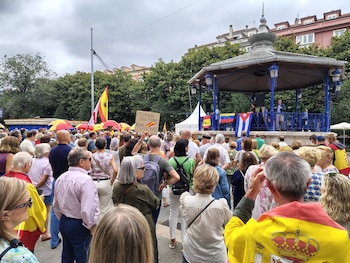
Hundreds of people – around 700 according to the organization – gathered this noon in Plaza de Pombo, Santander . The assembly coincided with the city’s big week , where attendees demanded the resignation of Spanish Prime Minister Pedro Sánchez (PSOE) and called for early elections .
The crowd, which primarily displayed Spanish flags and umbrellas in the colors of Spanish education , responded to a call from approximately thirty associations across various regions. This gathering was reinforced by a larger coalition, the platform for constitutional Spain , which encompasses over 120 organizations .
The assembly located its epicenter in the main temple of the central Santander Plaza , where representatives from diverse civil society groups presented speeches and read a formal manifesto condemning government actions.
Opposition to the “Unconstitutional Amnesty Law”
A focal point of the gathering was the call for the resignation of Prime Minister Sánchez alongside demands for electoral elections . The attendees aimed to express their discontent regarding the so-called unconstitutional amnesty law , which they argue enables Sánchez to govern with impunity in exchange for political favors from separatist factions . Protestors raised concerns that this legislation signifies an unprecedented attack on judicial independence , undermining the very fabric of the Spanish judicial system .
Moreover, the manifesto denounced the government’s purported complicity with the Venezuelan administration , which they labeled as a criminal usurpation . The gathering called for support of “ heroic winning opposition ” in Venezuela, reiterating their stance against governmental wrongdoing at home and abroad.
Leadership and Vision of Amalio de Marichalar
The initiative was spearheaded by Amalio de Marichalar , who, in remarks to Europa Press , articulated that the protest aimed to draw attention to a government that he believes has betrayed the fundamental principles of democracy. According to Marichalar, Sánchez is violating the Constitution and threatening the rule of law inherent to European governance . He expressed concern, stating, “We are in the midst of a coup attempt by a generation that seeks to erode all counterbalances.” This assertion was made in the context of Sánchez’s alleged exertion of control over judicial system checks and balances.
Marcos de Quintos , a noted businessman, emphasized that the concentration in Santander follows similar demonstrations in various Spanish cities such as Madrid , Seville , and Burgos . He asserted that citizens have the responsibility to take action, advocating that reliance on judicial entities alone is insufficient. “We cannot leave everything to the judiciary , as demonstrations like this provide momentum and support to our last line of defense for democracy,” he stated, lamenting the precarious situation under Sánchez’s administration.
Apart from Political Partisanship
The organizers emphasized that the assembly was intended to be non-partisan . Attendees were encouraged to refrain from carrying flags or symbols associated with any political party to maintain the event’s focus on collective grievances rather than individual political agendas.
As the crowd voiced its frustrations, the overall sentiment was one of unity against perceived threats to democratic principles and judicial integrity. The rally served as a platform for citizens to openly express their dissent against the current government, advocating for a return to foundational democratic values.
The event underscored a critical moment in Spanish politics, as citizens express their concerns over democracy and government accountability . The palpable tension and collective resolve hint at the potential for further demonstrations as the political landscape evolves in Spain.