
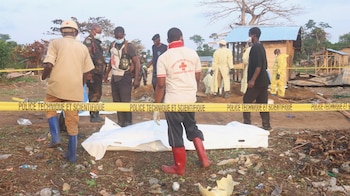
At least 43 people have died in a new attack attributed to the Allied Democratic Forces (ADF) , which has ties to the Islamic State jihadist group. This attack occurred approximately 75 kilometers southwest of the capital of Ituri Province , in Bunia , which is located in the eastern region of the Democratic Republic of the Congo (DRC) .
Details of the Attack
According to sources consulted by Radio Okapi , the attack took place in the town of Komanda . Tragically, among the victims, around twenty individuals were stabbed during a night vigil in a Catholic Church . It has been reported that bodies were discovered in homes and nearby businesses close to the church.
The security forces, currently deployed to apprehend those responsible for this horrific attack, indicated that the alarm was raised around 2:00 AM local time following the sighting of smoke rising from homes that had been set ablaze. However, by the time authorities arrived, the attackers had already fled the scene.
Community Response and Instability
In the aftermath of the attack, activities in the city have been suspended for the morning, and many residents have started to flee, fearing further violence. The radio station emphasized that this attack comes after several months of relative calm in the region, a period during which many displaced individuals had begun to return to their homes.
This recent incident is symptomatic of ongoing instability in eastern DRC, where a multitude of armed groups operate, often causing severe humanitarian crises. According to experts, the resurgence of violence implies a destabilization of the normally fragile peace that local residents had come to hope for.
History of the ADF
The Allied Democratic Forces emerged in the 1990s in Uganda but have gained notoriety for their brutal operations primarily in eastern DRC. They are known for committing atrocities and have reportedly murdered thousands of civilians over the years. The group experienced a significant split in 2019 when its leader pledged allegiance to the Islamic State in Central Africa (ISCA) , the official affiliate of the jihadist organization in the region. From that point onward, they have operated under the Islamic State banner, adopting more extreme tactics and expanding their operational reach.
The Impact on Civilians
The consequences of such attacks on the civilian population are devastating. Families are torn apart, livelihoods are destroyed, and fear permeates everyday life. The local economy often struggles to recover from the chaos wrought by violence, further exacerbating the issues of poverty and instability. This latest incident not only reaffirms the perilous situation faced by residents but also reveals the urgent need for effective governance and security measures to protect civilians.
Furthermore, humanitarian organizations are increasingly expressing concern for those displaced by the violence. Many of these individuals are in urgent need of shelter, food, and medical assistance. Aid agencies are often overstretched and underfunded, making it even more difficult to address the grave needs of the affected populations.
International Attention
The DRC’s persistent violence and humanitarian crises have not gone unnoticed on the international stage. Various organizations, including the United Nations , have called for increased attention and action to bolster security forces and aid programs in the region. The complexities of the crisis underscore the necessity for a multi-faceted approach that not only addresses the symptoms of violence but also considers the underlying causes such as poverty, unemployment, and political instability.
In light of these recent events, it is crucial for local and international stakeholders to collaborate in finding a sustainable solution to the ongoing violence. Without a concerted effort to restore security and improve living conditions, the cycle of violence may continue, leaving a tragic legacy for future generations in the DRC.