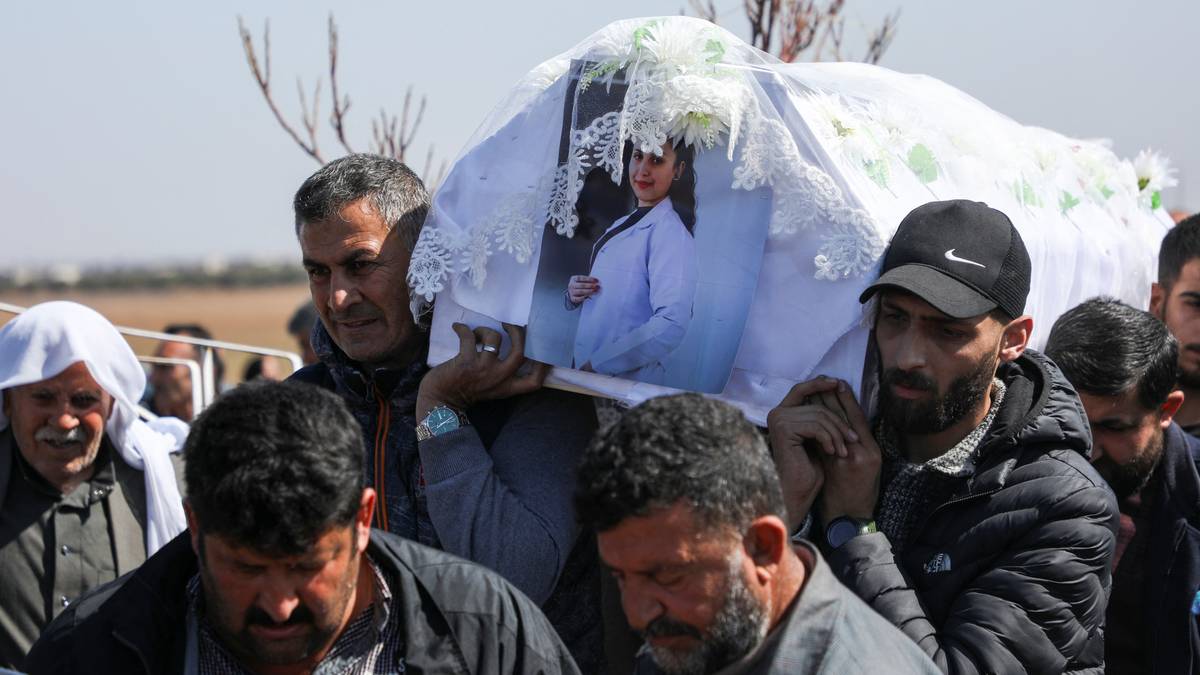
The coffin is covered with white lace and flowers. On the front is a picture of a young woman with a medical coat and a confident smile. According to first -year student Shinda Adil Kisho’s father, Adil Kisho, she was hit by shots after going to sleep in the apartment she shared with three girlfriends in Latakia. The apartment was on the fifth floor, according to his father. He even talked to her on the phone shortly before she was killed. Shinda Kisho (19) had completed the first year of the medical study in Latakia in Syria. Photo: Private – She should get up early the next day with her friends to eat before fasting. Suddenly she was hit as she lay in bed. They took her to hospital, but she couldn’t be saved, Kisho told news. On Sunday, the Kurdish 19-year-old was buried at the hometown of Qamishli in Syria. Friends and family in sorrow carried the coffin into the packed cemetery. The circumstances surrounding the shots at Kisho’s apartment are unclear. Although President al-Sharaa has taken power in Syria, a complicated political image remains. The country has, for 14 years of civil war, been characterized by many different military groups, with striking goals and motifs. In the country also live several different religious and ethnic groups, with a sometimes tense relationship with each other. In recent days, many people have been troubled again. Mournful on the grave of Shinda Kisho. The medical student was killed in the violence who has hit Syria in recent days. The medical student was killed in the violence who has hit Syria in recent days. The medical student was killed in the violence who has hit Syria in recent days. The medical student was killed in the violence who has hit Syria in recent days. Several massacres uncertainty prevailing in Syria after two days of reports of massacre and mass killings on civilians in the Syria coastal region. In particular, the killing of Alawites, a religious minority that Syria’s former president, Basher al-Assad, belonged to. In social media, images of corpses abound. Both young children and older men and women are killed in what looks like home, in stairwells and outdoors. Videos are also shared showing equality and brutal killings of men dressed in civilian clothes. news has also seen pictures of burnt corpses, and dozens of dead stacked on top of each other. news does not know the identity, religious affiliation of the killed or when the images were taken. Eyewitnesses in the city of Banyias that the BBC has spoken to say some of the attackers were men who spoke a language other than Arabic. Others were dressed in civil but armed. SVT’s freelancer Lina Malers says her sources tell of groups of armed men who go die to door and ask for Alawites. Will be investigating Syria’s recent President Ahmad al-Sharaa has on several occasions urged peace and reconciliation in the region. He has also promised an independent investigation of the recent events. On Sunday, he said that an independent committee should examine the violence and identify who is responsible for it, according to a statement published on Telegram. The reason for the mass murder should be an ambush attack on local government forces in the Tartus and Latakia regions, carried out by people connected to the fallen Assad regime. The regions are mainly populated by Alawites, which were over -represented in the country’s former army. In the wake of the matches, reports of mass murder on civilians, especially Alawites, have flourished. Some believe the mass killings are revenge for the ambush, although there are many Syrian Alawites without connection to the old regime. The killings are condemned by both the UN, the United States, Germany and the UK. Syrian authorities Monday say that the military campaign on the coast has ended. Facts about the war in Syria Folkeholden against Syria’s dictator Bashar al-Assad broke out in March 2011. The regime deployed the army and snipers against peaceful protesters. The protest wave spread to large parts of Syria. In parallel, an armed rebellion broke out that in 2012 developed into a full -scale civil war. A number of different rebel groups, many of them with support from other countries, have since fought against the regime and partly also against each other. Some of the rebels receive support from, among others, Turkey, Saudi Arabia, Qatar and the United States. Assad is supported by Russia, Iran and Lebanese Hezbollah. Following the outbreak of Borgerkirgen, several Islamist rebel groups emerged. In 2014, the far-reaching Islamist group proclaims itself as a caliphate with the center of Raqqa in Northern Syria. Since 2014, a US-led coalition has bombed IS in Syria and Iraq. It supports the Kurdish-led SDF force in Northern Syria, which fights for self-government and against IS. At the same time, Turkish government forces have fought against both IS and Kurdish militias. In 2019, SDF declared that IS was territorially defeated in Syria, and the United States pulled out most of its forces. Shortly after, Turkey began its own military offensive against the Kurds. Russia and Turkey got a ceasefire in 2020 that had a temporary end to the fighting between the rebels and the government forces. On November 27, 2024, rebels began with an Islamist group Hayat Tahrir al-Sham (HTS) at the forefront of a great offensive against the Assad regime. For the next few days, rebels took the cities of Aleppo, Hama and Homs, and on the night of December 8, they moved into the capital Damascus and declared that the Assad regime was crashed. The UN estimates that at least 250,000 have been killed in the war since 2011, but Syrian scientists believe the war has cost almost half a million lives. Half the population is driven on the run. According to UN internal refugees, 6.6 million has fled to other countries. Source: NTB/news unclear who is behind both the forces of the new government, the remains of the old regime, and militias that have so far not joined the government forces, have been accused of being behind the massacres. Professor Brynjar Lia at UiO has followed the development closely. He believes that several players are probably behind the killings of civilians. Brynjar Lia is a professor of Middle East studies at UiO, and follows the situation in Syria closely. Photo: Martin HW ZONDAG / news In particular, he highlights militia groups that have not yet joined the government forces of President al-Sharaa. Lia says armed civilians and members of independent militias are likely to enter the regions when the messages about the battles came. – Unorganized armed men left the provinces to help the security forces and take revenge on the Alawites. So you think there are those who have been behind some of these massacres that have seen a picture of, Lia tells news. Men affiliated with the government forces in the Syrian city of Latakia on Sunday. Photo: AFP He also thinks the security forces have probably been behind abuse against the people of the region, but do not think these are the ones behind the bulk of the attacks. In particular, he highlights the Syrian National Army (SNA) militia, which has joined the government’s new army, but which is still not completely integrated. Uncertain death toll The Syrian journalist Ahmad Primo, behind the Verify Sy website, says that there is currently much that is uncertainly related to the massacres. Primo believes the remains of Assad’s forces may have attacked Alawites who refused to join the rebellion against the new government. At the same time, he also believes that armed men, unrelated to the government forces, also may have attacked civilian Alawites, motivated by revenge for the Assad regime’s previous abuse. – In my opinion, none of them should be excluded. It is possible that both scenarios have taken place, says Primo to news. It is unclear how many people have been killed in the attacks. The human rights organization Syrian Observatory for Human Rights (SOHR) believes over 800 civilians, mainly Alawites, have been killed. Sohr seems to believe that it is the government forces behind a number of the attacks. Neither Primo nor Professor Lia is currently trusting the figures from the organization. – The criticism goes on two things. They have found errors in their numerical material, and they are not open about their methodology, says Lia. Government forces on their way into the fighting in the coastal regions in Syria earlier this week. Photo: AFP Refugee Council in Syria said Sunday that it fears that the sectarian violence could make the peace process trace. Lia is still optimistic about Syria’s future. He points out that Kurdish and religious leaders in Syria have not been blamed for the recent President al-Sharaa for the Death. He believes it depends on how the investigation of the killings will be, and that there will be a court settlement against those responsible. – I think there may be something good out of this. I think the tragedy can strengthen the will to gather for the goal of a stable and safe Syria. The Assad regime was hated by just about all Syrians, including the Alawites, and you will do everything to avoid the old regime getting control again. Published 10.03.2025, at. 12.36
ttn-69