
The Call for an Extraordinary Congress
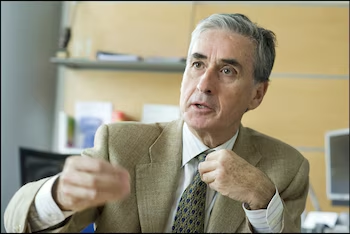
Ramón Jáuregui, a prominent voice within the Spanish Socialist Workers’ Party (PSOE), has called for an urgent extraordinary congress. This plea comes at a time when the party finds itself in a precarious situation, marked by significant internal strife and external challenges. As the former Minister of the Presidency under José Luis Rodríguez Zapatero, Jáuregui’s experience lends weight to his demands, reflecting the pressing need for a period of reflection and renewal within the organization.
Concerns About Internal Struggles
In an article for The Mail, Jáuregui expressed his shock at the serious allegations circulating within the socialist political landscape. He commented, “I never imagined such an accumulation of accusations, nor so serious.” This admission highlights the gravity of the situation, prompting him to warn of the potential political fallout from ongoing investigations.
“As these investigations proceed, the corporate damage will be enormous,” he noted, linking the current crises to what he perceives as the close of a political cycle for the party.
The Necessity of a Renewal Movement
Jáuregui believes that the PSOE must react promptly to regain trust and justify its government performance to the citizens. He asserted, “Regardless of political events, it is crucial that the party presents a clear explanation of what has transpired.” He argued that while recent socioeconomic achievements should be recognized, they alone do not guarantee future trust from the electorate.
He contends that a strong renewal movement within the PSOE is imperative for addressing challenges and redefining its ideological stance. According to him, an extraordinary congress could serve as the catalyzing event for this transformation, allowing party members to actively engage in determining leadership and strategy.
Reinforcing Internal Structures
A significant part of Jáuregui’s critique revolves around the changes in the party’s internal dynamics under current leadership. He observed that the federal leadership’s influence over local structures has intensified during Pedro Sánchez’s tenure. This trend, he argues, has hindered the PSOE’s ability to act as an autonomous political entity, consequently diminishing internal pluralism.
“To regain its strength, the party must encourage open discussion and reclaim spaces for political initiative,” he stated. He stressed that the PSOE should not merely react to external pressures but should proactively shape its future.
Debating Future Alliances and Strategies
Transitioning to the party’s strategic approach to alliances, Jáuregui called for an open dialogue about its political positioning, particularly regarding its relationship with the so-called “plurinational bloc.” He raised essential questions about whether this framework should remain central to the PSOE’s strategy, also advocating discussions aimed at preventing far-right factions from gaining political leverage.
Despite his criticisms, Jáuregui acknowledged that the current leadership has laid a solid ideological foundation for the party. However, he cautioned that the viability of this foundation is contingent upon an active response to the challenges ahead, rather than solely attributing difficulties to external factors.
Conclusion: Taking Initiative for the Future
Ultimately, Jáuregui’s demand for an extraordinary congress is a clarion call for PSOE members to unite and engage in self-reflection. He urged the party to take the initiative and openly confront its challenges, advocating for a renewed commitment to active leadership and innovative alliances moving forward. Only through such concerted efforts can the PSOE hope to recover its standing and shape its political future effectively.