
Google’s Gemini 3 Flash: A Game-Changer in AI Models
In a significant shake-up of the artificial intelligence landscape, Google has unveiled the Gemini 3 Flash, which has outperformed OpenAI’s GPT-5.2 Extra High in numerous performance benchmarks. This development compels us to reassess previously established norms in AI capabilities.
A Fast Model with Enhanced Reasoning
Google’s Gemini 3 Flash brings a compelling promise: that “speed and scalability do not have to come at the expense of intelligence.” Designed for efficiency in both cost and performance, it excels at reasoning tasks without compromising speed. In fact, the model is capable of adjusting its cognitive load, “thinking” longer when necessary while using 30% fewer tokens on average compared to Gemini 2.5 Pro. This ensures high precision in completing various tasks without delaying response times.
Benchmark Performance: The Proof is in the Numbers
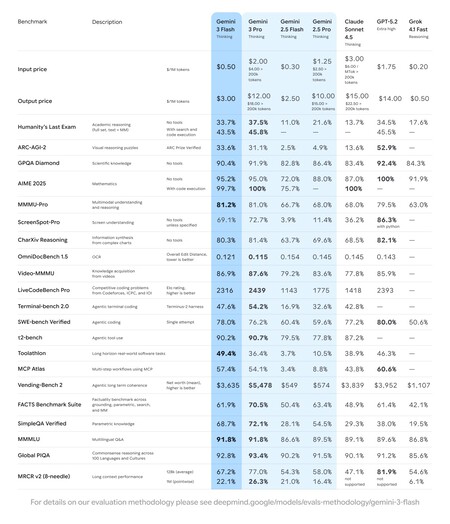
While benchmarks are not flawless, they remain one of the best methods for comparing competing AI models. Gemini 3 Flash performs admirably in this regard. For example, in the SimpleQA Verified tests, it scores 68.7% in reliability for knowledge questions, significantly outpacing GPT-5.2 Extra High’s 38.0%. In multimodal reasoning tests like MMMU-Pro, Gemini 3 Flash achieved 81.2%, while the OpenAI model reached 79.5%.
Multilingual and Cultural Insights
Taking a closer look at multilingual capabilities, Gemini 3 Flash excels with 91.8% performance compared to 89.6% for its OpenAI counterpart. In the Global PIQA test, designed for common sense across 100 languages, it achieves 92.8%, surpassing GPT-5.2 Extra High’s 91.2%. This suggests that Gemini 3 Flash is optimized for understanding nuances in diverse cultural contexts, making it a better choice for global applications.
Performance in Tool Usage
Gemini 3 Flash also outshines in tool utilization. In the Toolathlon challenge, it scored 49.4%, while the GPT-5.2 Extra High got 46.3%. The FACTS Benchmark Suite results were also closely contested, with Gemini 3 Flash at 61.9% versus 61.4% for OpenAI.
The Limits of Reasoning Performance
However, it’s important to note that while Gemini 3 Flash leads in several specific tests, it does not dominate in pure reasoning. In highly demanding reasoning assessments, such as the ARC-AGI-2 visual puzzles, OpenAI’s model takes the lead with 52.9% against Flash’s 33.6%. Similar trends are observed in code execution (AIME 2025) and software engineering tasks (SWE-bench Verified).
Understanding GPT-5.2 Extra High
It’s essential to clarify what GPT-5.2 Extra High is, as it has appeared frequently in comparisons. This terminology refers to the maximum reasoning level available in the OpenAI API for GPT-5.2. Officially, it is identified as “xhigh” for those familiar with OpenAI’s specifications.
Where to Access Gemini 3 Flash
Gemini 3 Flash is not limited by geography. Users of the Gemini app will automatically have access to this powerful model, while developers can integrate it through the API, AI Studio, and Vertex AI. Notably, in the United States, it has become the default AI model for Google’s search engine.
Pricing for Integration
For those looking to incorporate Gemini 3 Flash into their applications, the pricing is set at $0.50 per million input tokens and $3 per million output tokens. This marks a slight increase from Gemini Flash 2.5, which was priced at $0.30 for inputs and $2.50 for outputs.
Competitive Landscape in AI
The competitive field of AI is becoming increasingly tight. The days when Google lagged behind OpenAI or relied solely on Bard for competition are fading. Today, the rivalry is more technical and nuanced, indicating that the landscape is evolving rapidly.
Images | Google