
Where is it Better to Live? Exploring Quality of Life Perceptions
Subjectivity in Quality of Life Rankings
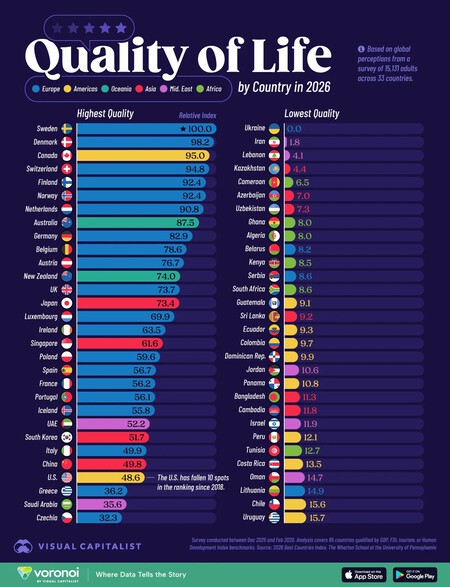
The question of “Where is it better to live?” is inherently subjective. People’s experiences and circumstances influence their perspectives, making comparisons challenging. The recent Wharton School’s 2026 Best Countries Index aims to tackle this complexity by assessing how citizens perceive the quality of life in various countries. Specifically, it evaluates 85 nations using 73 distinct attributes, which span from entrepreneurship and business openness to cultural influence and general quality of life. Over 15,000 participants from 33 countries contributed to this comprehensive survey, providing valuable insights into global perceptions.
Insights from the Index
The Wharton School’s index, while insightful, does not delve into objective metrics like GDP, infrastructure investment, or healthcare quality. Instead, it focuses on a country’s “brand image,” which can significantly influence its attractiveness for foreign investment and tourism. For instance, the United Arab Emirates climbed from 17th in 2024 to 10th in 2026, evidencing the positive impact of investments, such as airport upgrades and hosting the 2022 World Cup. Such improvements bolster perceptions of quality of life and consequently attract talent.
Europe’s Dominance in Quality of Life
Europe dominates the upper ranks of this index, with 20 out of the top 30 positions occupied by European nations, particularly the Nordic countries. Canada holds a strong position at 3rd place, while the United States lags behind in 27th, making it the lowest-ranked G7 economy. Notably, countries like Australia, Singapore, Japan, and even China have scored better in this perception survey, leaving the U.S. trailing.
Yet, countries facing significant challenges, such as Ukraine, Iran, and Lebanon, find themselves at the bottom of the list, illustrating how geopolitical factors can heavily skew perceptions.
Spain’s Place in the Rankings
The saying “As in Spain, you don’t live anywhere” resonates largely within the country itself rather than beyond its borders. In the Wharton index, Spain scored 56.7 out of 100, placing it 19th overall. This ranking puts it directly between Poland and France and highlights its standing as a leader among Mediterranean nations. While Spain is known for its vibrant lifestyle and culture, it does not score as highly as the Nordic countries, which have the advantage of solid economic structures and services.
Despite ranking lower in perceived quality of life, Spain attracts nearly 100 million tourists annually, according to INE data. This influx underscores the discrepancy between how life is experienced versus how it is perceived globally.
Perception vs. Reality
It’s crucial to understand that this index primarily reflects perceptions rather than actual living conditions. Stereotypes and cultural biases often overshadow individuals’ daily experiences within each country. Additionally, the sample size used in the survey may not fully encapsulate the realities of all 85 countries evaluated. Therefore, while the Wharton index provides an interesting perspective, it is essential to approach it with a critical eye.
Conclusion
In summary, the Wharton School’s 2026 Best Countries Index offers a fascinating view into how countries are perceived in terms of quality of life. While Spain may not rank as high as its citizens believe it should, the country’s allure remains strong, both for its residents and the millions of tourists it welcomes every year. Ultimately, the question of where it’s better to live will always hinge on personal experiences and preferences, making each answer uniquely subjective.