
The Fascinating History of Egyptian Blue
Not all treasures are made of jewels , gold , and precious stones . For years, a group of researchers from Washington State University has been in pursuit of a treasure equally captivating, yet far more elusive: Egyptian blue , the oldest known synthetic pigment. This remarkable hue was utilized by ancient Egyptian artists to decorate everything from alabaster bowls to coffins, ceramics, and murals. Despite its once widespread popularity—including its continued use by the Romans—the recipe for this pigment was lost over time.
Until now.
What is Egyptian Blue? This is one of those mysteries that has intrigued archaeologists for decades. Egyptian blue is essentially a dye notable for two primary reasons. First, it is the oldest known synthetic pigment still recognized today, dating back thousands of years. Second, its blue shade allowed artists to use it as a substitute for much more expensive minerals such as turquoise or lapis lazuli .
Although we refer to it as “Egyptian blue” in general terms, the pigment was incredibly heterogeneous . Depending on where it was produced, how the material was processed, and the quality of its components, the color could range from gray to a deep blue or even a muted green. One of the factors influencing the pigment’s hue was the speed at which the mixture cooled.
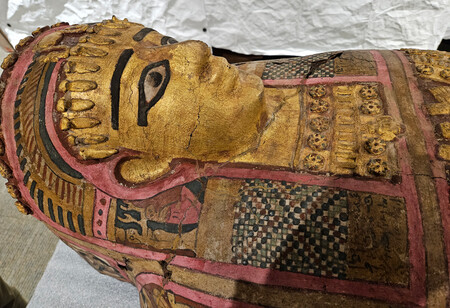
How ancient is it? Quite ancient. We know that Egyptian blue was in use as early as 5,000 years ago . In fact, the oldest known sample is a small alabaster bowl made around 3250 BCE . The pigment was employed in ceramics, sculptures, murals, and sarcophagi. To this day, these artifacts display the pigment’s striking blue tone. It was also applied to various surfaces, including wood, stone, and cartonnage, a material similar to papier-mâché.
Was it only the Egyptians who used it? Not at all. The color was so admired that Roman artisans incorporated it into their palette following the conquest of ancient Egypt. It was even used during the Renaissance . The Smithsonian Institute noted that several years ago, it was discovered that the renowned artist Raphael employed Egyptian blue in his fresco titled ” The Triumph of Galatea ,” created for the Villa Farnesina in Rome during the early 16th century.
While Raphael’s intention might have been to emulate the ancient Roman technique, Washington State University (WSU) specifies that by the Renaissance, the pigment’s formula had nearly vanished from memory. A research team from WSU has sought to rectify this, collaborating closely with the Carnegie Museum of Natural History and the Smithsonian Conservation Institute .

How did they accomplish this? Through trial and error. The team meticulously examined samples of the pigment and developed 12 different recipes while experimenting with various raw materials and processing times. Their findings are detailed in a paper published in NPJ Heritage Science , outlining how they worked with mixtures of silicon dioxide , copper , calcium , and sodium carbonate . The primary ingredient is cuprorivaite .
The process involved heating the mixture to 1,000 degrees Celsius for varying times, between one and 11 hours, to replicate the conditions of ancient kilns. The resulting samples were then allowed to cool at different rates to study their pigments using microscopy and analysis techniques. They compared the results with actual artifacts from ancient Egypt.
Is it that complicated? Beyond the materials and mixing techniques, the primary challenge for archaeologists has been replicating the exact shades that ancient Egyptian artisans once used. “One of the things we observed was that with small variations in the process, we obtained vastly different results,” states John McCloy , one of the study’s authors and the director of WSU’s School of Mechanical and Materials Engineering. “There were artisans who made the pigment, transported it, and then used it elsewhere.”
During their study, the researchers discovered that to achieve the purest blue shade , only half the components required for the blue color were necessary. “No matter what the rest contains, that’s what surprised us,” McCloy adds. “You can see that each particle contains numerous elements. It’s far from uniform.” In fact, WSU acknowledges that one of the conclusions reached by the experts is that the pigment is surprisingly diverse .
Did they achieve their goal? It appears so. In a recent statement, WSU revealed that after testing various formulas and closely examining the results, their team has successfully “recreated” the famed Egyptian blue. This achievement is not merely a matter of curiosity or an advancement in understanding ancient Egyptian art. WSU notes that the renewed interest in Egyptian blue is driven by more pragmatic reasons .
“In recent years, interest in this pigment has resurfaced due to its optical , magnetic , and biological properties , with potential new technological applications,” the institution states. “The pigment emits light in the near-infrared spectrum , which is invisible to the human eye, potentially allowing it to be used for purposes like fingerprinting and creating anti-counterfeiting inks .”
Images Credit: Washington State University, Matt Unger, Joshua Franzos, and Carnegie Museum of Natural History.
In conclusion, the journey to rediscover Egyptian blue has not only illuminated ancient practices in art and pigment creation but has also opened avenues for modern applications that could benefit from this remarkable color. With each step of the research, both ancient history and contemporary science merge, demonstrating the enduring legacy of one of archaeology’s most captivating mysteries.