

A New Era for the German Economy: Working More Hours
Germany has long been viewed as the economic powerhouse of Europe. However, the nation is currently grappling with an unexpected crisis that has left analysts and experts reeling. The economic model that once allowed Germany to flourish with reduced working hours and high productivity seems to be hitting a wall. In response, German leaders are exploring new strategies to recover lost growth, with one potential solution gaining traction: working more .
The discussion about how much Germany works has intensified in recent months, yet officials have struggled to find effective solutions to the economic stagnation. Voices from Bavaria, Germany’s southeastern region, argue that increasing annual working hours could be a straightforward fix. A drastic proposal is to eliminate one of the religious holidays from the German calendar.
As reported by the newspaper Welt, Chancellor Friedrich Merz reportedly supports this assertion: “We need to return to working more in this country, and above all , we need to work more efficiently,” he stated, later clarifying that there are indeed groups, especially among the younger generation, who are already working significantly hard.
Attempts at Reform. Pilot programs implementing a four-day workweek have not delivered the needed boost in productivity that the country requires. Chancellor Merz recently warned, “With a four-day workweek and a balance between professional and personal life, we will not be able to sustain the prosperity of this country,” as he stated in an interview with Le Monde. His remarks have stirred discontent in a society that has always prided itself on being hard-working and disciplined.
Over the decades, German workers have benefited from shorter working hours compared to their Southern European counterparts. This discrepancy was justified by the high productivity rates and the value added through German products and services, permitting the nation to achieve “much with little.” Yet, the economy now struggles to gain traction, leading the government to cite ” lack of work ” and a “preference for leisure” as impediments to economic growth.
Cutting Holidays. Given the current climate, certain business leaders have proposed concrete measures to extend working hours without lengthening daily schedules, many of which already exceed 40 hours due to substantial overtime.
According to Bild, Bertram Brossardt, CEO of the Bavarian Employers’ Association, suggested the elimination of at least one public holiday. “Easter Monday, Whit Monday, and St. Stephen’s Day. My colleagues in France and Italy are constantly surprised that we have these days off. Removing one of these holidays would greatly benefit the German economy and wouldn’t be a heavy burden for employees,” he claimed, emphasizing that “religious holidays shouldn’t be a taboo in this debate.”
Statistical Support. Brossardt’s proposal is not merely symbolic. Christoph Schröder, a researcher at the German Economic Institute (IW), argues that eliminating a holiday could increase Germany’s GDP by up to €8.6 billion. Furthermore, Michael Hüther, head of the IW, pointed to Denmark, which recently scrapped a holiday that netted an additional €400 million for the state budget. The challenge remains that all federal states, each with authority over their holidays, must reach a consensus on any changes.

Germany’s Low Working Hours. Brossardt’s claims are further supported by compelling data. In 2023, the average German employee worked 1,343 hours annually, 92 hours less than in Austria, 186 hours less than in Switzerland, and 391 hours less than in Italy, according to OECD data. “We are not productive enough. To remain competitive, we must work more ,” the entrepreneur stated to Bild.
Despite these figures, Germany does not have the highest number of public holidays. On average, Germans enjoy nine national holidays, though regions in the south like Bavaria, Baden-Württemberg, and Saarland can have up to twelve. In comparison, Austria and Malta have thirteen holidays.
In Spain, twelve holidays are common, with regions such as Catalonia, Valencia, and Navarra adding up to thirteen; Ceuta has fourteen, while the Canary Islands settle for eleven holidays.
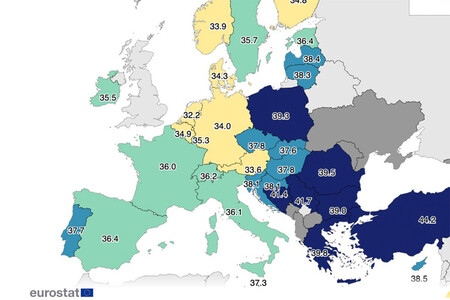
Average weekly working hours in each country
The Issue Is Not Just About Holidays. However, as discussed in El Confidencial, some experts believe that simply cutting down on holidays will not solve Germany’s economic issues. Instead, they argue that the country must undergo a transformation in its labor market to regain its former productivity levels. Germany is the second-lowest country in Europe in terms of hours worked per week for full-time jobs, and the figure declines even further when considering part-time contracts. According to official data, one in two women in Germany works part-time.
Consequently, some economists suggest encouraging women to enter the full-time labor market and facilitating the entry of more foreign workers to address the skilled labor shortage. The key, according to these experts, lies in a comprehensive review of the German labor market to adapt to its new economic and demographic challenges, particularly the aging workforce.
In conclusion, Germany stands at a crossroads in its economic evolution. The discourse around working hours and productivity highlights a critical juncture for identifying a path forward to bolster its economy amid changing global dynamics. As the nation seeks to strike a balance between work and personal life, addressing these issues will be pivotal in shaping Germany’s economic future.