
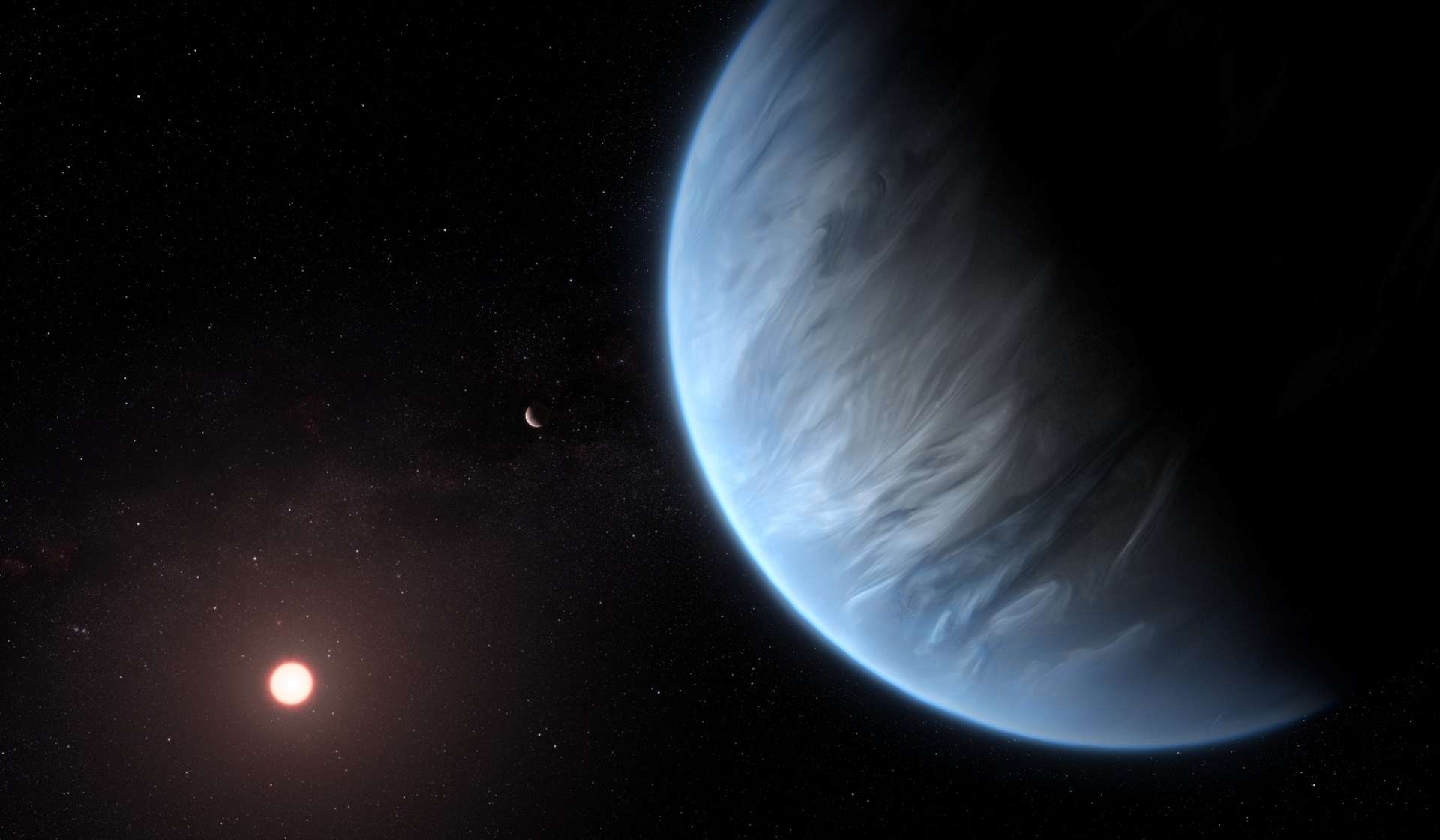
The Exciting Discovery of Exoplanet K2-18b
In April 2025, a team led by Nikku Madhusudhan, a professor at the University of Cambridge, stirred up excitement within the scientific community regarding an exoplanet found through observations from the Kepler Space Telescope. Utilizing the advanced capabilities of the James Webb Space Telescope (JWST), the researchers delved into atmospheric analysis technique through transmission spectroscopy, announcing a startling discovery concerning exoplanet K2-18b. This planet orbits a red dwarf star located approximately 124 light-years away from our Solar System in the Leo constellation.
The team’s previous findings, shared in 2023, revealed that K2-18b, with a radius about 2.6 times that of Earth and about 8.6 Earth masses, exemplifies a new concept known as a "hycean" planet. This term refers to a ocean-world that likely possesses a vast global ocean of liquid water beneath a thick atmosphere predominantly made up of hydrogen.
James Webb Space Telescope capturing data of exoplanets.
A planetary atmosphere features a spectral signature that represents its chemical composition as well as the constituents of its clouds and fog. Different techniques, including spectroscopic transit and secondary eclipse observations, are used to determine the physical and chemical characteristics of an exoplanet’s atmosphere. This remarkable analysis has enabled researchers to probe into the essence of these distant worlds.
A Dubious Ocean World
Despite the initial excitement, scientists including Franck Selsis and Jérémy Leconte from the Bordeaux Astrophysics Laboratory expressed skepticism regarding the existence of K2-18b’s ocean. While K2-18b resides in the so-called habitable zone, its temperature is likely too high for liquid water to exist on its surface. Instead, it might be covered in magma due to its orbit around the red dwarf star, completing a full cycle in just 30 days.
The prevailing view among the scientific community is that K2-18b is not truly habitable. Most notably, the focus on this exoplanet intensified when Nikku Madhusudhan and his team reported credible yet cautious findings of two sulfur-bearing molecules. The presence of these molecules could only be explained through biological activity akin to phytoplankton in Earth’s oceans.
The Search for Signs of Life
The discovery of these sulfur compounds, particularly dimethylsulfide (DMS), a compound uniquely produced by Earth’s phytoplankton, has created a buzz in astrobiological discussions. Although intriguing, this finding is far from conclusive as it raises questions about potential abiogenic processes that might yield similar molecules.
Skeptics argue that there are no established biosignatures strongly indicative of biological activity detected on K2-18b. Furthermore, most scientists quickly pointed out the irrationality of attributing the spectral evidence provided by JWST to DMS or other sulfur compounds in the atmosphere of K2-18b. The last announcement from Nikku Madhusudhan, although prudent, elicited criticism from many researchers.
The Debate Intensifies
Further complicating the narrative, a recent article submitted to esteemed journals like Astronomy and Astrophysics Letters added fuel to the fire. Both Rafael Luque and Michael Zhang, scholars involved in this inquiry, have indicated that the existing data is too noisy to substantiate claims of biosignatures. Luque emphasized the necessity for compelling evidence, as Carl Sagan famously noted, "Extraordinary claims require extraordinary evidence."

Researchers in discussion regarding K2-18b’s findings.
The debate continues as the scientific community seeks to better understand the atmospheric nuances of K2-18b. The challenges inherent in identifying molecular signatures that accurately confirm the presence of life-forming conditions echo throughout the discussions. With advancements in technology like the JWST, researchers remain hopeful that future explorations will unravel the mysteries surrounding this intriguing exoplanet.
Moving Forward
As the interest in K2-18b persists, the ongoing discussions highlight the necessity for cautious interpretation of scientific data. While K2-18b holds compelling possibilities, it serves as a reminder of the complexities involved in exoplanetary studies and the challenges of differentiating between biological and abiotic signals in atmospheric samples.
The quest for understanding distant worlds is an evolving journey, filled with excitement and skepticism, as scientists strive to unveil the enigmas of the universe, allowing us to ponder the existence of life beyond our planet.