

What was the total stablecoin market cap when Ethereum first crossed the $1,400 mark in January 2018? How much has Ethereum’s stablecoin market cap increased by May 6, 2025? What percentage of the current market is dominated by Tether (USDT)? What significant changes are expected with Ethereum’s upcoming upgrade this month? What factors are contributing to the stablecoin market’s maturity according to the article?
When Ethereum first crossed the $1,400 mark in January 2018, the network’s total stablecoin market cap stood at a humble $124,500.
According to DeFiLlama data, as of May 6, 2025, that figure skyrocketed to a massive $124.5 billion, marking a one-million-fold increase.
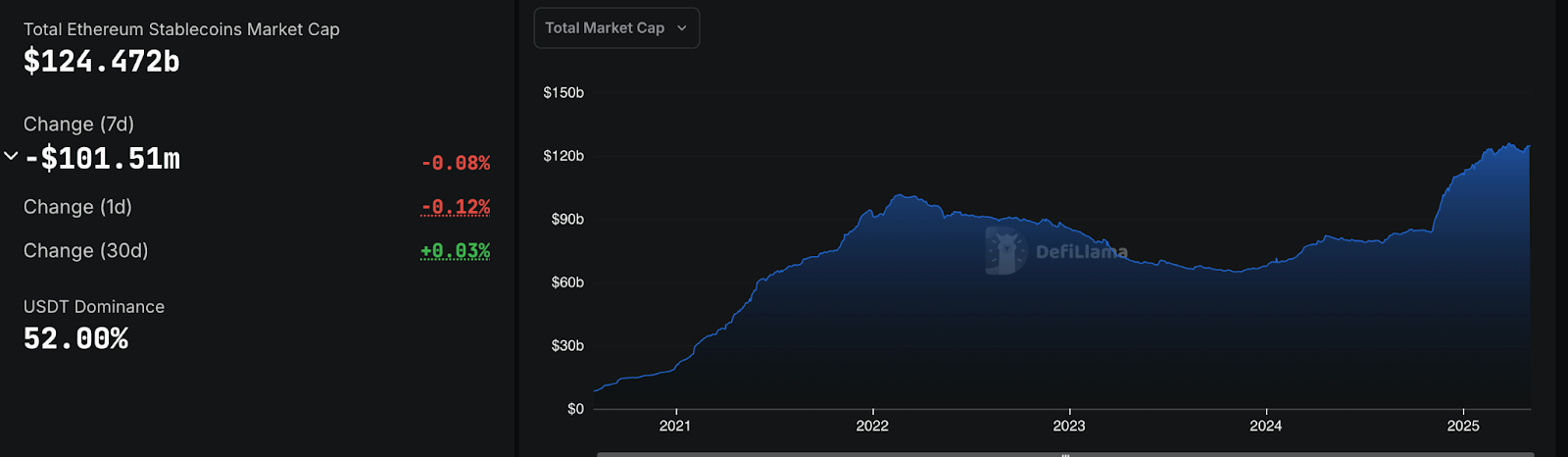
This rapid rise has not occurred in isolation. Ethereum’s stablecoin market is now the dominant layer for digital dollar liquidity, with Tether (USDT) leading the charge at 52% market dominance, accounting for $64.7 billion of the current $124.5 billion total.
USD Coin (USDC) follows at $37 billion, trailed by Ethena’s USDe at $4.5 billion. Other major contenders include Sky Dollar’s USDs ($3.8 billion), DAI ($3.6 billion), BlackRock’s BUIDL, Ethena’s USDtb, FDUSD, USDO, and PayPal’s PYUSD.
Despite a minor weekly drop of 0.08%, around $100 million, the ecosystem remains highly active.
Ethereum is trading at $1,804, up 10.9% in two weeks. Its market cap is $216 billion, and its daily trading volume is $9.2 billion.

This growth comes as the blockchain gears up for a pivotal upgrade this month, which includes EIP-7251. The change will substantially increase the maximum stake from 32 ETH to 2,048 ETH, potentially transforming validator operations, increasing decentralization, and improving overall on-chain efficiency.
Stablecoin Market Matures: Institutions, Regulations, and Adoption Fuel Growth
The total stablecoin market now stands at nearly $240 billion globally, close to an all-time high. Over $5 billion in new supply was added in the last week of April alone, and year-on-year figures are even more telling.
The #stablecoin market nears $240B all-time high with $5B weekly surge, as Citigroup forecasts $2T by 2030 amid global crypto payment adoption.#Stablecoins #CryptoGrowth https://t.co/NhG8kYtwlK
— Cryptonews.com (@cryptonews) April 29, 2025
Active stablecoin wallets jumped from 19.6 million in February 2024 to 30 million by February 2025, a 53% increase. Supply also soared from $138 billion to $225 billion during the same period.
Additionally, Tether continues to dominate, with over 61% of the global market share. Yet the increasing presence of alternatives like USDC, USDe, and DAI reveals a maturing ecosystem.
A convergence of institutional interest, technological progress, and political will is also reshaping the regulatory terrain. Citi now projects stablecoins could surpass $2 trillion in market cap by 2030, and in its optimistic outlook, that number balloons to $3.7 trillion.
Citigroup has projected a rise in stablecoin market, forecasting its total market cap to soar from $240 billion to $2 trillion by 2030. #Stablecoin #Citigrouphttps://t.co/tGNT3XfNC0
— Cryptonews.com (@cryptonews) April 25, 2025
Mastercard has emerged as a surprising champion of stablecoins. The company recently unveiled a comprehensive framework that allows 150 million merchants to accept digital dollars through a “360-degree” strategy.
Mastercard announced its partnership with payments processor Nuvei, Circle and Paxos to enable a seamless stablecoin payment ecosystem.#Mastercard #Stablecoin #OKXCardhttps://t.co/VyzaH9fRyY
— Cryptonews.com (@cryptonews) April 29, 2025
Collaborating with payment processors like Nuvei and stablecoin issuers Circle and Paxos, Mastercard has developed infrastructure that supports wallets, card issuance, on-chain remittances, and instant merchant settlement.
Another payments giant, Stripe, is entering the fray with its own USD-backed stablecoin to expand payments beyond North America and Europe.
While price headlines have often painted a bearish picture, Ethereum was reportedly down 45% in Q1 2025; the underlying metrics tell a different story.
Bitwise’s Q1 report dubbed it “The Best Worst Quarter in Crypto’s History.” In Q1 alone, stablecoins settled a record $27.6 trillion on-chain, surpassing Visa’s 2023 settlement volume of $12 trillion. Interestingly, Ethereum is the settlement layer for most of this activity.
Stablecoins settle $27.6 trillion in Q1 2025, doubling Visa’s annual volume, as Ethereum’s infrastructure dominates global digital payments, even amid price turbulence.#Stablecoins #Ethereumhttps://t.co/LVFclqLGPX
— Cryptonews.com (@cryptonews) April 18, 2025
Ethereum’s infrastructure has become more scalable with the rise of Layer 2 solutions like Base, Arbitrum, and Optimism. These networks offer sub-cent transaction fees and have absorbed a large transaction volume from the Ethereum mainnet.
Ethereum’s median fees were just $0.66, making it competitive even at scale, but developer activity remains unmatched as Ethereum still has the highest average developer count in the industry.
Q1 2025 also witnessed profound political and institutional alignment with crypto. Following the inauguration of a pro-crypto U.S. president, digital assets were named a national strategic priority.
Executive orders followed, including forming a Strategic Bitcoin Reserve and rollbacks of restrictive guidance like SAB 121. Banks received permission to custody crypto assets, and lawsuits by the SEC were dropped, reversing the earlier “Operation Choke Point 2.0.”
@coinbase has uncovered @FDICgov documents revealing efforts to halt crypto banking activities, exposing a systematic push against the industry.#Coinbase #FDIChttps://t.co/Wr6DByXffC
— Cryptonews.com (@cryptonews) January 3, 2025
Yet, through all this, Ethereum’s real strength wasn’t in its token price and function. It remained the go-to chain for DeFi, payments, and smart contract innovation.
Even as other chains like Solana showed momentary bursts in revenue or user growth, Ethereum’s foundation remained unshaken, spanning everything from Uniswap’s $1.03 billion in revenue to rollup adoption.
The rise of stablecoins has put Ethereum at the epicenter of a massive financial transformation. What was once a speculative network for ICOs is now powering trillions in global settlement value.
The post Ethereum Stablecoin Market Explodes 1M-Fold to $124B – What’s Driving It? appeared first on Cryptonews.
Ethereum Stablecoin Market Explodes 1M-Fold to $124B – What’s Driving It?
In the rapidly evolving landscape of cryptocurrencies, one phenomenon has gained unprecedented traction: the Ethereum stablecoin market. Over the past few years, this sector has surged dramatically, expanding 1 million-fold to a staggering market cap of $124 billion. This explosive growth has raised eyebrows and prompted a closer examination of the trends, technologies, and economic principles propelling stablecoins into the limelight.
Understanding Stablecoins
Stablecoins are digital currencies designed to maintain a stable value, usually pegged to a fiat currency like the U.S. dollar. Unlike traditional cryptocurrencies such as Bitcoin or Ethereum, which are known for their volatility, stablecoins provide a means for users to transact with reduced risk. They leverage various mechanisms—collateralization, algorhythmic stability, or even a combination of both—to achieve their price stability.
Ethereum, as a leading blockchain platform, has become an incubator for these stablecoins. Its smart contract functionality allows developers to create a variety of stablecoin types, each catering to diverse needs and market conditions.
Factors Driving the Explosive Growth
Increased Demand for DeFi:
The rise of decentralized finance (DeFi) platforms has been one of the most significant drivers of stablecoin adoption. DeFi enables users to lend, borrow, and earn interest on their crypto assets without the need for traditional financial intermediaries. Stablecoins serve as the backbone of these platforms, facilitating seamless transactions and providing liquidity. As more users flock to DeFi for various financial services, the demand for stablecoins has surged significantly.
Institutional Adoption:
The entry of institutional investors into the cryptocurrency arena has bolstered the credibility and use case for stablecoins. Institutions seek stability in their investments, and stablecoins offer a bridge between traditional financial systems and the digital asset ecosystem. Corporate giants and financial institutions are increasingly turning to stablecoins for treasury management and cross-border transactions, contributing to the overall growth of the sector.
Market Volatility and Hedging:
As the cryptocurrency market experiences periodic volatility, traders often seek refuge in stablecoins. During market downturns, many opt to convert their digital assets into stablecoins to preserve value. This trend of using stablecoins as a hedge against volatility has been particularly notable during significant market corrections, further pushing the demand for these digital currencies.
Cross-Border Transactions:
The ability of stablecoins to facilitate cross-border transactions is another key factor driving their growth. Traditional banking systems often impose high fees and lengthy transaction times for international money transfers. Stablecoins enable instantaneous transfers with minimal fees, making them an attractive alternative for individuals and businesses engaged in international trade or remittances.
Regulatory Clarity:
Regulatory developments surrounding cryptocurrencies and stablecoins are increasingly becoming clearer. Governments and regulatory bodies are beginning to define frameworks that could legitimize and regulate stablecoins. This increased clarity has encouraged users and investors to engage more actively in the stablecoin market, fostering confidence and stimulating growth.
Innovation in Stablecoin Options:
The Ethereum ecosystem supports a wide array of stablecoins, ranging from well-known names like Tether (USDT) and USD Coin (USDC) to innovative projects like DAI. Each stablecoin employs unique mechanisms and provides differing user experiences. The diverse offerings allow users to choose stablecoins that best meet their needs, further increasing user adoption.
The Future of Ethereum’s Stablecoin Market
The explosive growth of the Ethereum stablecoin market to $124 billion is likely just the beginning. Analysts predict that as the DeFi space continues to expand, so will the demand for stablecoins. Furthermore, as more individuals and institutions recognize the benefits of blockchain technology in financial transactions, the stablecoin market is expected to witness even more robust growth.
However, challenges remain. Regulatory scrutiny is intensifying, and concerns about the underlying assets backing stablecoins, particularly concerning transparency and liquidity, need to be addressed. The market is also highly competitive, with continuous innovation creating both opportunities and threats.
Conclusion
The rise of the Ethereum stablecoin market marks a pivotal moment in the evolution of finance. Driven by demand for DeFi, institutional interest, and the need for stable digital assets in a volatile market, stablecoins have carved out a unique niche. With continued innovation and regulatory developments, the potential for growth in this sector remains significant, making it an exciting area to watch in the broader cryptocurrency landscape. As more individuals and businesses embrace stablecoins, the future promises to be dynamic and transformative.
The Ethereum stablecoin market has experienced explosive growth, skyrocketing from $100 million to $124 billion. This massive surge is attributed to several key factors:
DeFi Ecosystem Expansion: The rise of decentralized finance (DeFi) platforms has significantly increased the demand for stablecoins, allowing users to lend, borrow, and trade with greater flexibility.
Increased Adoption: More users and institutions are adopting Ethereum-based stablecoins for transactions, reflecting trust in the cryptocurrency space and its stability against volatile assets.
Yield Farming: Investors are drawn to yield farming opportunities offered by stablecoins, where users can earn interest on their holdings through various protocols.
Cross-Border Transactions: Stablecoins provide a convenient solution for cross-border transactions, leveraging the Ethereum network to facilitate quicker and cheaper transfers.
Market Sentiment: Positive market sentiment and growing interest in blockchain technology and cryptocurrencies have spurred investment and usage of stablecoins.
- Regulatory Attention: As stablecoins gain visibility, regulatory frameworks are beginning to take shape, which may provide clarity for users and institutions, further promoting adoption.
The combination of these factors showcases a shift in how users engage with cryptocurrency, making stablecoins an integral part of the digital asset landscape on Ethereum.