
Trump’s Controversial Meeting with Cyril Ramaphosa
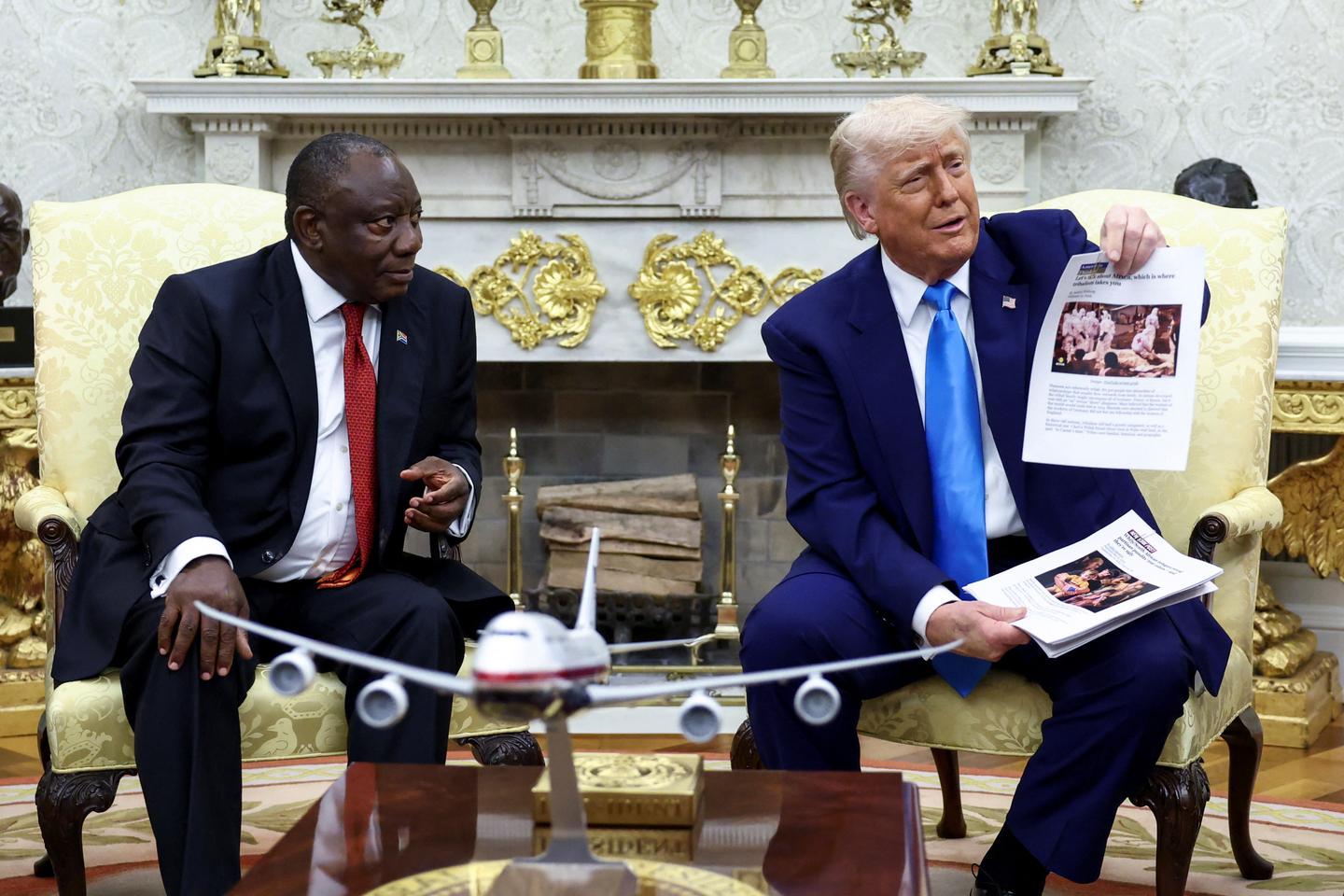
On May 21, 2025, an unprecedented political event transpired in the Oval Office of the White House, marking a significant moment in U.S.-South Africa relations. Donald Trump, the former president, was set to interview South African President Cyril Ramaphosa, but the meeting quickly morphed into an unexpectedly tense spectacle, characterized by Trump’s long-standing obsession with the plight of Afrikaners—white farmers in South Africa.
The atmosphere was electrified with anticipation and unease. Ramaphosa, aware of the political climate, braced for a confrontation reminiscent of **Ukrainian President Volodymyr Zelensky’s** experience a few months earlier. In that earlier engagement, Zelensky faced Trump’s pointed interrogations regarding political favors and alliances. But as Ramaphosa stepped into the **Oval Office**, he found himself ensnared in a trap set by the former president that offered no means of escape.
Sparks Fly Over Afrikaner Advocacy
In the lead-up to this meeting, the Trump administration had already demonstrated discontent towards South Africa by suspending U.S. aid and expelling the South African ambassador. During the meeting, Trump wasted no time in pivoting towards one of his pet issues: the persecution of Afrikaners. He referred to "documentaries and news articles," suggesting a pre-packaged narrative that painted a bleak picture of South Africa’s socio-political landscape.
In a dramatic turn of events, Trump requested the lights to be dimmed as he prepared to showcase a multimedia presentation. This request transformed the Oval Office into an **assize court**, where facts were not merely examined but were presented as conclusive evidence of **systemic oppression** against Afrikaners. A **four-minute video** played, consisting of **graphic** images of tombstones alongside excerpts from inflammatory speeches made by the marginal political figure **Julius Malema**, whose controversial rhetoric typically galvanized nationalist sentiments.
The Media’s Role in Political Spectacles
The presence of journalists during this political spectacle was critical. This meeting was more than a simple diplomatic engagement; it was a carefully orchestrated affair designed to capture headlines and provoke reactions both domestically and internationally. Trump has long understood the power of media to amplify his narratives, and this meeting was no exception. By involving the press, Trump aimed to solidify his base while simultaneously discrediting South Africa’s government.
The choice of Malema’s speeches further fueled concerns. While he is often deemed a radical, his views resonate with parts of the South African electorate. Trump’s presentation painted a picture in stark black and white, ignoring the complexities of the **political landscape** in South Africa. Such oversimplification is emblematic of Trump’s broader approach to foreign policy—characterized by **brashness** and a lack of nuanced understanding.
The Implications of Trump’s Claims
The resurgence of Trump’s claims regarding Afrikaners has deep implications. Given South Africa’s complex history of apartheid and subsequent societal restructuring, the depiction of Afrikaners as perpetual victims plays into a narrative that could provoke racial discord. It is essential to remember that while there are legitimate concerns over land reform and property rights, framing these issues without context can lead to misunderstandings that echo far beyond U.S.-South Africa relations.
Notably, Trump’s political gambit appears aligned with his broader strategy to leverage **cultural tensions** and historical grievances. For many in his voter base, these narratives resonate deeply, tapping into fears of demographic change and economic displacement. Whether intended or not, this strategy is often polarizing.
Consequences for South Africa and Global Standing
For President Ramaphosa, this meeting was a delicate balance. As he faced Trump, he had to navigate not just the immediate concerns of bilateral relations, but also the domestic implications of being commandingly scrutinized during such a publicized encounter. The stakes were high; any perceived weakness could embolden opposition groups at home, while a strong performance could restore some level of international credibility.
The fallout from this meeting has already begun to unfold. Analysts predict that it could strain U.S.-South African relations further, especially in light of ongoing trade agreements and post-pandemic recovery initiatives. The South African government has responded by reiterating its commitments to land reform while also emphasizing the importance of **diplomatic dialogue** over polarized media narratives.
A Broader Reflection on Diplomatic Engagements
Ultimately, the Trump-Ramaphosa meeting serves as a case study in how diplomatic interactions can be transformed into political theater, where the stakes extend beyond the immediate political players involved. It highlights the complexities and challenges of engaging in meaningful international dialogue in an age marked by polarization and sensationalism. As global citizens, understanding these dynamics helps illuminate not just U.S.-South Africa relations, but the intricate tapestry of international politics at large. Through this lens, future diplomatic engagements could sit perilously at the intersection of strategy, ethics, and public perception.