
Understanding the Predation Dynamics of Baby Sauropods in the Late Jurassic
During the Late Jurassic, around 150 million years ago, the land that is now the western United States was teeming with massive ferns, conifers, and sprawling rivers. Among this abundance, some of the largest dinosaurs, the sauropods, emerged, yet their offspring faced significant vulnerabilities. Recent research by paleontologist Cassius Morrison from University College London reveals how these baby dinosaurs became prime targets for large predators, reshaping our understanding of Jurassic ecosystems.
The Vulnerable Offspring of Giants
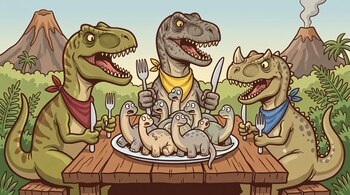
Under the looming shadows of titans like Diplodocus and Brachiosaurus, baby sauropods started their lives at merely a few dozen centimeters tall and entirely vulnerable. Unlike many modern species, these young dinosaurs likely had no parental protection after hatching, similar to today’s sea turtles. This absence of care left them exposed to not just environmental threats, but primarily to hungry carnivores.
A Study at Dry Mesa
The findings come from a comprehensive analysis of fossil remains uncovered at the Dry Mesa site in Colorado. Morrison’s team identified at least six species of sauropods, including Apatosaurus and Haplocanthosaurus. Their research indicates that baby sauropods were prominent prey for large predators such as Allosaurus and Ceratosaurus. The study, published in the New Mexico Museum of Natural History and Science Bulletin, emphasizes this predatory relationship, revealing how crucial baby sauropods were to the entire food chain.
The Ecological Impact
The size disparity between adult and young sauropods made hunting the latter much easier for carnivores. Adult sauropods, with their massive bulk and defenses, presented a significant risk to predators, while their young were comparatively defenseless. This led to a system in which predatory dinosaurs relied upon the abundance of baby sauropods for sustenance, ensuring stability in their populations.
The abundance of these young creatures allowed predators to recover from injuries sustained while hunting other species. Fossils showing healed fractures in predators like Allosaurus suggest they often faced danger but could still thrive, largely thanks to the availability of baby sauropods.
Reproductive Strategies and Ecosystem Dynamics
Sauropods employed a reproductive strategy that involved laying hundreds of eggs each season, akin to many contemporary reptiles. While this high-output, low-parental-care strategy leads to a significant infant mortality rate, it also created a “mobile food base” for carnivores, supporting their populations.
As baby sauropods were a constant source of nourishment for predators, their survival became a defining aspect of the ecosystem’s balance. However, the evolutionary success of the sauropods paradoxically hinged on the substantial loss of their young.
Evolutionary Consequences
The study raises important points about the relationship between the decline of sauropods toward the late Cretaceous period and the evolution of large carnivores. As baby sauropods became increasingly scarce, this shift would have forced predators to adapt and evolve into powerful hunters to tackle more formidable prey like Triceratops.
Conclusion
The research led by Morrison and his team challenges traditional notions of Jurassic ecosystems, shifting focus from mere battles between giants to a more intricate balancing act where the vulnerabilities of young dinosaurs structured the entire food chain. Understanding these dynamics offers new insights into the life cycles and ecological interrelationships of prehistoric species, reminding us that even in the age of giants, the smallest beings can hold the balance of life in their fragile hands.