
A New Solar System That Shouldn’t Exist
Recent observations from NASA and the European Space Observatory have unveiled a fascinating yet perplexing discovery: a new exoplanetary system located 116 light years away from Earth. According to research led by an international team from the University of Warwick, published in the journal Science, this new “solar system” challenges our current understanding of planetary formation.
The Peculiar Architecture of LHS 1903
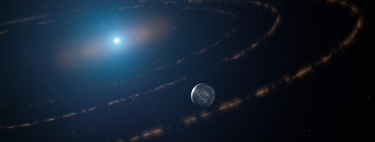
The LHS 1903 system consists of four planets orbiting a red dwarf star, the most common and enduring type of star in our universe. What stands out about this system is its unique arrangement: the innermost planet is rocky, the next two are gaseous, and surprisingly, the outermost planet, LHS 1903 e, is also rocky. This configuration raises eyebrows among scientists as it contradicts the conventional models of planetary formation.
Why the Outermost Planet Shouldn’t Be There
LHS 1903 e is classified as a super-Earth, boasting 1.7 times the radius and 5.79 times the mass of Earth. Based on current astrophysics, a rocky planet of this size should not be located in the outer cold zone of a star. The established theory dictates that rocky planets should occupy the inner zones, while gas giants like Jupiter should be situated in the colder outer regions, beyond what is known as the “snow line.”
Implications for Planetary Formation Theories
The existence of LHS 1903 e brings forth the possibility that our prevailing theories on planetary formation may be flawed or incomplete. If this system’s architecture represents a new paradigm, it opens doors to reconsidering other similar systems. Since red dwarfs are the most prevalent stars in our galaxy, this anomalous setup could suggest that many other planetary systems have been misunderstood.
A Possible Explanation for the Anomaly
The research team proposes a “gas-poor formation mechanism” as an explanation for this unusual layout. They suggest that the planets formed sequentially in the opposite order of what is typically observed in our solar system, starting with the innermost rocky planet and moving outward. LHS 1903 e would have formed last, at a time when there was insufficient gas left to develop into a full-fledged gas giant.
Research Methods
The international team’s data was gathered through a collaboration between NASA’s TESS telescopes and ESA’s CHEOPS satellite. TESS, through its transit method, detects exoplanets, while CHEOPS subsequently studies these planets in depth, yielding valuable information on size, mass, and density. Various alternative hypotheses, such as the planet’s formation from collisions or the loss of a gaseous envelope, were considered but ultimately dismissed.
The Future of Astrophysical Research
This groundbreaking discovery raises critical questions about the mechanisms behind planet formation. According to Néstor Espinoza, an astronomer at the Space Telescope Science Institute, the LHS 1903 system offers substantial insight that will fuel ongoing research for years to come. The anomalies presented by this exoplanetary system not only broaden the horizon of our understanding but may also uncover new pathways in astrophysics.
As we continue to explore the universe, the implications of LHS 1903 could signify that our understanding of solar systems is still evolving, and that many mysteries about planetary formation await resolution.