
Political Tensions Surround Sub-21 Eurocup Qualifiers: A Football Match Turned Controversial
Coach Vujadin Boskov famously quoted, “Soccer is football,” emphasizing the universality of the sport. Yet, despite its reputation as the “king of sports,” football often intermingles with economics, art, and politics. Recently, a qualifier match for the U-21 Eurocup featuring Kosovo vs. Spain has brought these connections to the forefront, blurring lines between sportsmanship and national identity.
This upcoming clash in Pristina should purely be a sporting event ; however, it has evolved into what some are calling an al-Andalus vs. “Kosovo territory” scenario.
Controversy Unveiled: What Happened?
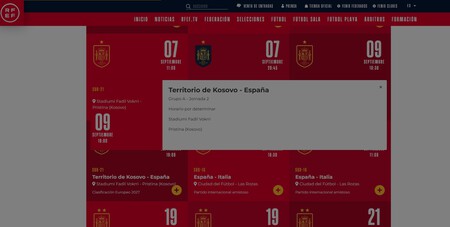
During the qualification match set for today, a heated controversy has emerged—not about the game itself, but the politics surrounding it . The Royal Spanish Football Federation (RFEF) labeled Kosovo as “Kosovo territory” in their official communications, a terminology that has sparked irritation and frustration within the Kosovo Football Federation (FFK).
The Heart of the Dispute
Why is such a word choice problematic? Kosovo declared its independence from Serbia in 2008 , but this status remains a subject of debate internationally. Many nations recognize Kosovo as a sovereign entity, while others, including Spain, continue to view it differently. The FFK’s unease about the term “territory,” which undermines its sovereign status, is deeply rooted in this complex geopolitical landscape. With ongoing tensions between the Albanian and Serbian populations, the FFK’s stance becomes increasingly significant.
RFEF website.
Royal Federation Response
The RFEF’s decision to label Kosovo in a manner that provoked the FFK was not accidental; it appears on their official calendar for September. The match scheduled for this afternoon at the Fadil Vokrri Stadium was specifically referred to as “Kosovo-Spain territory.” This terminology reflects a deeper issue of recognition, even as other sections of their website simply refer to it as Kosovo without the added connotation.
FFK Takes Action
In light of this, the FFK reacted strongly, sending a letter to UEFA President Aleksander Čeferin and RFEF President Rafael Louzán expressing their disappointment. The official communication highlighted that such references “do not recognize Kosovo as a sovereign nation.” The FFK has been clear: this is not the first time the RFEF has used language that undermines their status.
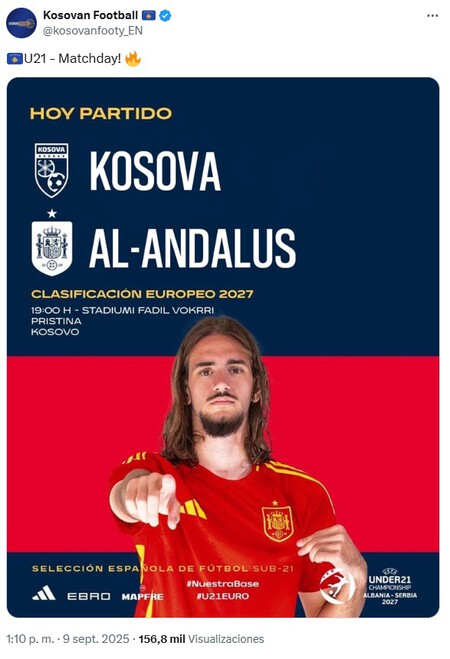
Click on the image to see the Tweet.
Knock-on Effects in the Sporting World
The situation escalated further as the Kosovan football community took to social media to express their sentiments. The Kosovan Football account posted a mock advertisement referring to Spain as ” al-Andalus ,” the historical territory under Muslim rule from the eighth to the fifteenth century, provoking widespread media attention and sparking conversations about cultural identity. This tweet accumulated thousands of views, showcasing the power of social media in framing modern controversies.
This incident not only shines a light on the intersection of sports and politics but also underlines the broader implications of recognition and national identity. As the match day approaches, both teams appear set to compete, yet the issues surrounding it remain as significant as the game itself.