
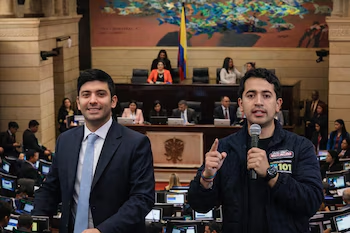
The Pulse for the Presidency of the House of Representatives in the New Government of Abelardo de la Espriella
On July 20, 2026, a new legislative period will commence in the Congress of the Republic, shaping the leadership of the House of Representatives and the Senate. Among the key candidates for the presidency of the House are Nicolás Barguil of the Conservative Party and Daniel Briceño of the Democratic Center, both of whom bring distinct backgrounds and perspectives to the table.
Leadership Rotation
The leadership arrangement for the House of Representatives has been strategically outlined: the Conservative Party will hold the presidency during the first year, followed by the Liberal Party, then the Democratic Center, and finally Cambio Radical. This structured rotation reflects a consensus aimed at balanced governance among the parties.
Nicolás Barguil: A Conservative Contender
Nicolás Antonio Barguil Cubillos, born on February 2, 1984, in Montería, Córdoba, serves as a Representative for the Córdoba Constituency. A graduate of Sergio Arboleda University with a specialization in Public Management and an MBA, Barguil has a solid academic foundation. His professional experience spans over 14 years in the agroindustrial sector, where he held various managerial roles and contributed as a consultant.
Barguil’s focus in Congress has centered on agricultural and energy policies, notably authoring a bill for a Hydrogen Economy, which aims to position Colombia favorably in the clean energy transition. His portfolio also highlights initiatives to improve rural living conditions and enhance agricultural production.
Daniel Briceño: The Watchdog
Daniel Felipe Briceño Montes, from Bogotá, is a lawyer with a strong focus on public law and political analysis. With a track record of over 247,000 votes in the latest legislative elections, Briceño has gained attention for his rigorous scrutiny of state spending. His initiatives include advocacy for transparent public procurement processes and training citizens to better engage with government operations.
Briceño has documented over 600 cases of irregularities in public management, showcasing his dedication to accountability. He leverages digital tools and social media for political engagement, representing a modern approach to constituent interaction and oversight.
Contrasting Perspectives
The dialogue surrounding Barguil and Briceño extends beyond their credentials. Briceño has expressed concerns that appointing Barguil as president could signify a shift in power towards the Historical Pact, raising questions about political alliances and allegiances. This ongoing debate underscores the competitive nature of Colombian politics, reflecting the varying priorities and strategies within party lines.
Conclusion
As the date approaches for naming the next president of the House of Representatives, the spotlight remains on Nicolás Barguil and Daniel Briceño. Each candidate not only embodies their party’s ideals but also represents the divergent paths Colombian governance may take in the coming legislative period. The election of the House’s president will undoubtedly have far-reaching implications, shaping policies that impact agriculture, energy, and public accountability in Colombia.