
The Rise of Kimi K3: A New Era in AI
It seems like yesterday when DeepSeek R1 challenged the long-held belief that the race for advanced artificial intelligence was exclusively in the hands of Silicon Valley. The emergence of its Chinese counterpart, particularly the Kimi K3 model, has disrupted this narrative, causing significant shifts in the tech landscape.
Kimi K3 Takes the Lead
Launched by Moonshot AI, Kimi K3 boasts an astonishing 2.8 trillion parameters and has rapidly ascended to the top of the Frontend Code Arena. This marks a notable achievement, eclipsing prominent models from companies like Anthropic and OpenAI. Developers are already leveraging this powerful model to create user interfaces, games, and various interactive applications, showcasing its practical implications beyond mere classification.
Frontend Code Arena Rankings
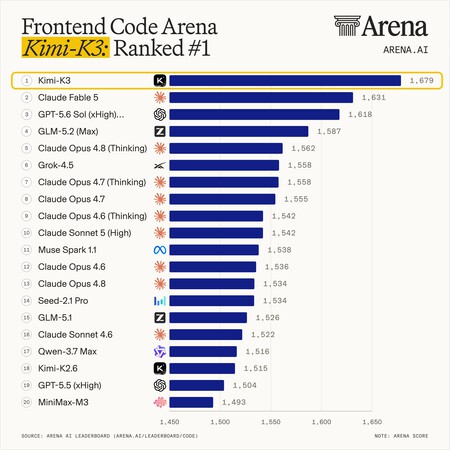
As of now, Kimi K3 holds an impressive score of 1,679 points in the Frontend Code Arena. It outpaces Claude Fable 5 at 1,631 and GPT-5.6 Sol xHigh at 1,618. This represents a remarkable improvement from its predecessor, Kimi K2.6, which ranked 18th. While these results are labeled as preliminary, the rankings indicate Kimi K3’s strong performance in the evaluated areas.
Evaluating Performance
Frontend Code Arena is not an all-encompassing test; rather, it evaluates web applications created by various AI models, measuring their efficacy, reliability, and user experience. While Kimi K3 leads in frontend capabilities, these results don’t necessarily extrapolate to performance in backend tasks, mathematics, or general reasoning.
Competitive Landscape
In broader assessments, Kimi K3 maintains a competitive edge but not without challenges. Vals AI ranks it second among 38 models with a score of 74.70%, just behind Claude Fable 5 at 75.14%. Similarly, it is placed third on the Artificial Analysis Intelligence Index.
Unique Capabilities
Kimi K3 excels in complex tasks that integrate programming and visual elements. The model supports web interface design and demonstrates high performance in agent programming tests. Notably, its “vision in the loop” capability allows it to adapt its output dynamically, making it effective at transforming visual references into interactive products.
Cautions and Considerations
Despite its impressive performance, it’s crucial to approach Kimi K3’s achievements with caution. While it is marketed as an open-weight model, its files are yet to be published, and the timeline for this release is projected for July 27. Additionally, while it features a sparse architecture activating 16 of its 896 experts, configurations recommended for optimal performance are far beyond what a conventional computer can offer.
Community Engagement and Innovation
The enthusiasm surrounding Kimi K3 is palpable, reflected in community projects like a browser-based recreation of macOS 27, crafted by several model agents over three hours. The community has also showcased innovations like Ballista, an interactive 3D panel, and tests against competitors like Claude and GPT, further demonstrating Kimi K3’s potential.
Conclusion: The Race is On
While it is still premature to declare Kimi K3 as the definitive front-runner in AI, its successful launch signifies a shift in the competitive landscape. With models like Claude Fable 5 and GPT-5.6 Sol still leading in several assessments, it’s evident that the gap between these entities is shrinking. Kimi K3’s potential is undeniable, but its journey is just beginning, and the AI race is far from over.
Images | Kimi | Screenshot
In Xataka | China has a plan to win the AI war against the US. And DeepSeek is its champion.