
The Impact of Increased Air Tourism on Housing Rents in Spain
In 2022, Spain welcomed a staggering 96.8 million foreign tourists, with a remarkable 80.5 million arriving via airports. This figure, representing over 83% of the total influx, underscores the pivotal role that air travel plays in Spain’s tourism sector. Consequently, to accommodate this surge, several airports are expanding to avoid any collapse from the tourist boom. However, this rapid increase raises a pressing question: What impact does this influx of air travelers have on the Spanish real estate market?
The Influence of Tourism on Housing Markets
Tourism has long been acknowledged as a significant factor in residential real estate, often leading to a shift from long-term housing to vacation rentals, thus inflating prices. A recent report by the New Economics Foundation (NEF), commissioned by Transport & Environment (T&E), dives deep into how increased air tourism is set to influence rental prices in Spain and beyond.
Key Findings from the NEF Report
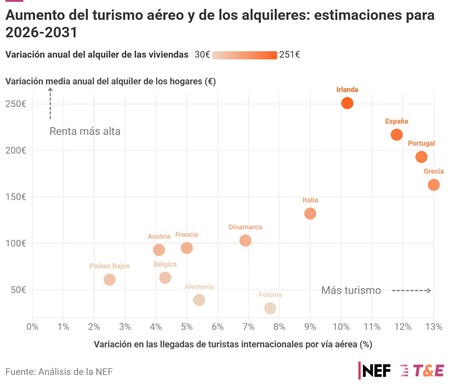
The NEF’s analysis reveals a direct correlation between air tourism and the housing market. As tourism escalates, so do the rents, particularly in key tourist destinations, adversely impacting low-income households. Specifically, the report projects that average rents in major European economies will rise by over €150 annually within the next five years.
For Spain, the situation appears more severe, with anticipated annual rent increases of €217 by 2031. This translates into an additional 1.6% increase each year, culminating in a staggering €648 million added to the rental burden for landlords across the country.
Regional Disparities in Rental Increases
The report highlights significant disparities based on geographical factors. In countries heavily reliant on tourism, such as Greece, Portugal, and Ireland, expected annual rent hikes are €163, €193, and €251, respectively. This trend exemplifies the struggle for tenants, especially in the most popular tourist areas.
Focus on the Major Tourist Regions
Tourist hotspots like the Balearic Islands and Canary Islands face an overwhelming influx of visitors, leading to specific regional challenges. These areas exhibit a ratio of 9.2 tourists per resident and 4.9 tourists per resident, indicating acute pressure on local housing markets.
Underlying Causes of Rising Rents
Several factors contribute to the surge in rental prices, many of which extend beyond tourism. The imbalance of supply and demand, slowed construction rates, and rising material costs exacerbate the issue. While tourism influx undoubtedly plays a role, local market dynamics and broader economic trends should not be overlooked.
Broader Economic Implications of Increased Tourism
The report by T&E further illustrates that the influx of tourists does not always equate to enhanced economic well-being for local workers. In 2023, despite the hospitality sector accounting for 10% of labor hours, it only represented 5% of Spain’s total gross added value. This indicates that job creation in the tourism sector may not directly foster better living standards for employees.
Furthermore, the rising tourist rental market may divert investment from productive sectors, resulting in a dependency on lower productivity and higher rents.
Conclusion
The growing air tourism in Spain promises economic benefits through increased traveler spending. However, these advantages come at a steep cost to local residents, particularly in terms of rising rents and housing availability. As the country balances the burgeoning tourism influx with the needs of its residents, finding sustainable solutions will be paramount.
Images courtesy of Tomek Baginski, Transport & Environment (T&E), and Phil Mosley.