
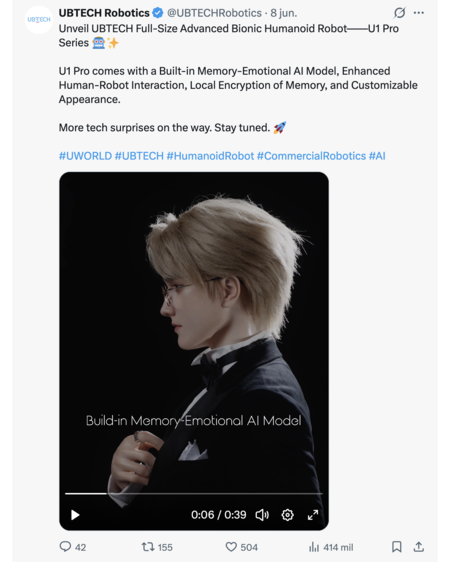
UBTech Robotics recently unveiled its first humanoid robot designed for home environments, named the U1. Unlike traditional industrial robots, the U1 features silicone skin, real hair, and “emotional AI,” enabling it to remember conversations for months, effectively making companionship a commercial product.
Three Versions, Three Pricing Tiers
The U1 comes in three variants: Lite, Pro, and Ultra, with prices ranging from €15,500 to €127,000 for the advanced model. Available in male (183 cm) and female (168 cm) forms, these robots are equipped with 88 servo joints and run on a Rockchip RK3588 chip, processing user data locally rather than relying on the cloud.
In-Depth Functionalities
Going beyond the capabilities of typical chatbots, the U1 maintains eye contact, recognizes emotional states through tone and facial expressions, and boasts a response latency of just 20 milliseconds. This AI engages in sustained relationships, learning from past conversations and adapting its behavior based on the user’s mood.
High Demand, Promising Future
Even before production begins, UBTech has announced over 13,000 reservations, with deliveries slated to start in September. Furthermore, an agreement with Siemens aims to manufacture 10,000 units per year, showcasing the strong demand for this kind of technology.
Tackling Loneliness
In China, statistics reveal that approximately 90 million adults live alone, with an additional 118 million seniors whose children no longer reside with them. The U1 aims to provide companionship, remind users to take medication, and even detect signs of fatigue or stress, ensuring that owners feel they won’t be “betrayed or abandoned.”
Ethical Considerations and Customization
For an extra fee, users can customize the robot’s appearance, making it resemble loved ones who have passed away or even fictional characters. This capability raises ethical questions reminiscent of the “uncanny valley” effect, echoing themes from pieces like the Black Mirror episode ‘Be Right Back.’
Limitations to Consider
Despite its advanced features, the U1 has major limitations, including a battery life of only four hours. Unlike other robots designed for household tasks, the U1 does not clean or cook. Additionally, intimate relationships are out of scope, as UBTech asserts that all conversation data is encrypted and not utilized for training AI models.
China’s Robotics Ambitions
This launch highlights China’s ambition to dominate the global robotics market, as it already accounted for 85% of humanoid robot integrations last year. With over 140 Chinese companies producing various models, the rise of home-based robots seems inevitable.
Future Prospects
While initial reactions to the U1 are mixed—with attendees expressing surprise at the natural-looking skin but noting slow response times—many experts believe that rapid advancements in this field are likely. Today’s prototypes may evolve significantly in the coming years, making thoughtful engagement with these technologies all the more crucial.