
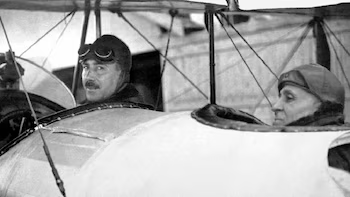
The Daring Odyssey of Two Pilots: Crossing the Ocean in Fragile Aircraft
A Dangerous Mission
Crossing the South Atlantic in a wooden and fabric aircraft during the 1920s was considered a ticket to certain death. However, Portuguese aviators Carlos Viegas Gago Coutinho and Artur de Sacadura Cabral dared to challenge the vastness of the ocean and the technological limitations of their time, marking one of aviation history’s most remarkable epics.
The Journey Begins
The adventure commenced on March 30, 1922, when they took off from Lisbon on a mission blending national pride, technical innovation, and immense bravery. Their aim was to pay tribute to Brazil for its centenary of independence through a feat that many deemed impossible. The journey concluded with a spectacular landing in Rio de Janeiro on June 17, 1922, after nearly three months of challenges, innovative solutions, and unwavering dedication.
Navigational Innovations
The pilots selected a Fairey IIID seaplane, adapted specifically for their mission and named Lusitania. Equipped with a 375 horsepower Rolls-Royce engine, it represented a significant step forward for its time. Yet, once the coastline disappeared from sight, any malfunction could leave the crew at the mercy of the treacherous ocean.
Gago Coutinho’s earlier research on navigation played a crucial role. As a geographer and maritime expert, he believed in applying age-old seafaring techniques to aviation. He innovated the traditional sextant by adding an internal bubble, creating an artificial horizon. This allowed pilots to navigate even without visible ocean horizons, guiding them safely through the clouds.
Challenges at Sea
As they flew from Lisbon to Las Palmas, the initial legs of the journey went smoothly. However, the true test awaited as they departed from Cape Verde. Their goal was the archipelago of São Pedro and São Paulo, an isolated group of rocks over 1,000 kilometers off the Brazilian coast. Finding these islands would serve as a practical demonstration of the efficiency of their new navigational methods.
During the journey, adverse winds hampered their progress, causing fuel consumption to rise. As time passed, constant adjustments became vital to counter atmospheric currents. The precision of Coutinho and Cabral’s instruments gained unprecedented significance as they navigated this vast expanse.
A Dramatic Turn
Upon approaching the archipelago, tragedy struck when the Lusitania crashed while attempting to land. Severe damage to one of its floats made the plane sink. This loss felt like the end of the expedition, but they were rescued by a Portuguese Navy vessel. Instead of marking the end, this incident sparked international media interest, propelling the mission into the public eye.
A Second Chance
The Portuguese government decided to continue the mission, confident in the scientific value of the project. A second Fairey seaplane was dispatched. However, this aircraft faced technical difficulties as well, leading to another emergency landing.
Despite the setbacks, both pilots gained fame, and public anticipation grew. Their journey represented the boundaries of aviation and the real potential for transoceanic flights.
Completion of the Mission
Finally, a third Fairey seaplane, named Santa Cruz, was sent to complete the expedition. On June 17, 1922, it successfully landed in Guanabara Bay, Rio de Janeiro, fulfilling the epic journey’s purpose. This achievement confirmed the potential for long-distance aerial navigation through rigorous methods, paving the way for future air travel advancements.
A Legacy of Precision
The journey established that astronomical navigation could effectively serve long-distance aviation over open waters. This ability was crucial during an era when radio communications were limited.
The innovations by Gago Coutinho and Sacadura Cabral laid foundational principles that contributed to modern aerial navigation. Their trip not only reshaped perceptions of oceanic barriers but also made the dream of connecting continents via regular flights a credible endeavor. Just four years later, other aviators would follow in their footsteps, prompted by the pioneering efforts of Coutinho and Cabral.
Conclusion
This expedition holds a prominent place in aviation history, illustrating how science and navigation could significantly expand the scope of air transport. Their legacy remains, proving that with knowledge and precision, even the most daunting challenges can be overcome.