
Mexico Expels CIA Agents Following Drug Laboratory Incident
President Claudia Sheinbaum Pardo recently announced the expulsion of two CIA agents from Mexico after their involvement in the discovery of a drug laboratory in Morelos, Chihuahua. This decision was revealed during a morning press conference held on May 27, where Sheinbaum clarified the circumstances surrounding their presence in the country.
Legal Entry but Lacking Accreditation
Despite the agents entering Mexico with appropriate diplomatic and tourist passports, they lacked the accreditation required by the Ministry of Foreign Affairs (SRE) for collaborating on security matters. This oversight gave rise to the request for their expulsion.
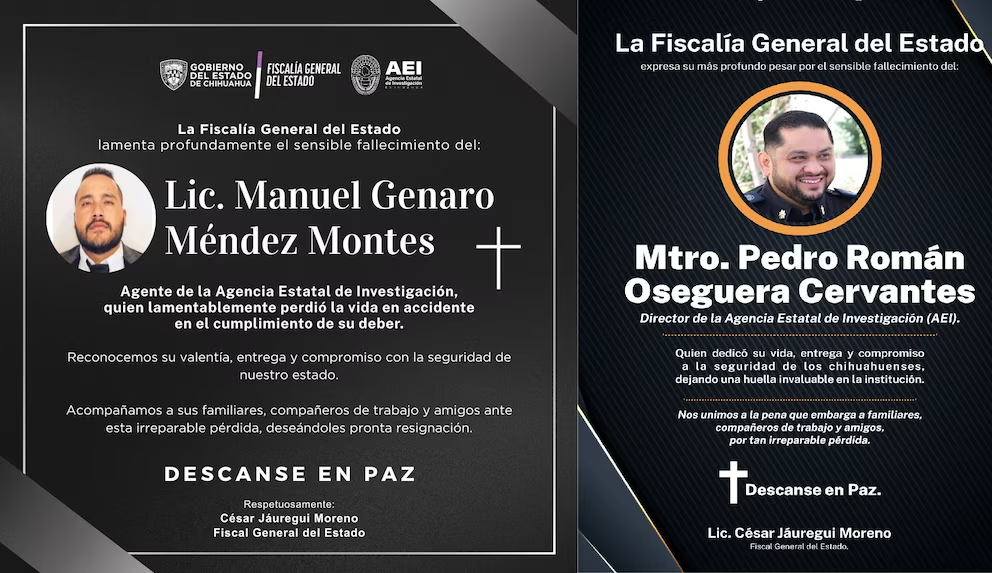
Sheinbaum highlighted that of the four CIA agents who were present, two had tragically died in a car accident unrelated to their intelligence activities. “We asked that the two who did not have accreditation leave the country, and they complied,” she stated clearly.
Security Protocols and Their Misstep
The president explained that while the agents entered the country legally, they failed to register properly for any intelligence work. This point was reiterated by the Security Cabinet, which noted that one agent entered as a visitor without permission for paid activities, while the other used a diplomatic passport but also lacked the necessary authorization.
“If they come to conduct intelligence work, a protocol must be followed for their stay to be approved via the Ministry of Foreign Affairs,” Sheinbaum elaborated. Despite their legal entry, these agents were not registered, thus compromising their ability to operate within legal bounds.
Dialogue with the U.S. Embassy
Following their violation of protocol, Sheinbaum indicated that the request for their departure was communicated to the United States Embassy. In a cooperative dialogue between the embassy and the SRE, it was decided that the agents would return to their home country.
Contradictory Accounts and Investigative Findings
Recent investigations by the Specialized Unit of the Attorney General’s Office of the State of Chihuahua have hinted at a more complex narrative. Reports indicate that the CIA agents were present with the then-director of the State Investigation Agency (AEI), Pedro Roman Oseguera, who was also involved in a different accident later.
Key findings from these investigations suggest that the agents lived with Oseguera for at least two days before the operation which led to the lab’s discovery. One agent was even noted to be carrying a long weapon just hours before the operation launched.
Furthermore, all four agents were reported to have accompanied Oseguera during the operation without presenting themselves as foreign operatives. They concealed their identities by wearing face masks and refrained from wearing State Prosecutor’s Office uniforms, casting doubt on their direct involvement or the nature of their mission.
This situation raises significant concerns regarding international intelligence operations in Mexico and the protocols required for foreign agents operating on its soil. As investigations continue, the implications of this incident on Mexico-U.S. relations and intelligence protocols remain to be seen.