
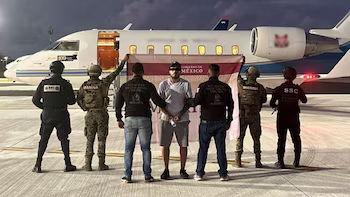
Hells Angels Member Arrested in Cancun
A significant development occurred recently when a member of the notorious Hells Angels motorcycle club was arrested in Cancun, Quintana Roo. This operation was carried out by the Secretariat of the Navy, in collaboration with the Secretariat of Security and Citizen Protection and the Attorney General’s Office of the Republic.
Identification and Charges
The individual apprehended was identified as Denis “N”, who held an Interpol red notice issued in Budapest. Canadian authorities have filed an extradition request against him for his alleged involvement in international drug and firearms trafficking. Informants indicate that he is not just a member but a leader within the Hells Angels, specifically known as Denis Ivzuki.
Details of the Arrest
The operation was initiated following intelligence shared by the Royal Canadian Mounted Police (RCMP), which identified Benito Juarez as a central area where the suspect was known to operate. Authorities have accused Denis “N” of being a logistics operator for the organization, significantly contributing to international violence through his activities associated with criminal associations, crimes against health, and transnational extortion.
Upon his arrest, Denis “N” was informed of his legal rights and subsequently handed over to the Federal Public Ministry, which will oversee his legal proceedings.
Commitment to International Cooperation
The Security Cabinet underscored its commitment to combating transnational organized crime through international cooperation while maintaining respect for human rights and the rule of law. The Mexican government’s actions reflect its dedication to addressing global criminal networks that pose threats not only within its borders but also internationally.
Background on the Hells Angels
Founded in 1948 in Fontana, California, by Ralph “Sonny” Barger, the Hells Angels are known as an international criminal organization masquerading as a motorcycle club. According to research conducted by Albert De Amicis, a professor at the University of Phoenix, Arizona, the organization is structured into local chapters referred to as charters. Each charter has its own leadership, including a president, vice president, sergeant-at-arms, intelligence officer, and route captain.
Criminal Activity and Global Reach
The United States Department of Justice classifies the Hells Angels as a criminal enterprise involved in various illicit activities, including homicide, drug manufacturing and distribution (methamphetamines, cocaine, heroin, and marijuana), and the illegal trade in firearms. Notably, to maintain membership, individuals within the organization are compelled to engage in drug distribution.
Moreover, many incarcerated members have forged connections with Mexican drug trafficking organizations, which escalates their drug production and distribution activities in states like Arizona. An instance of this is seen in 2003, when the Bureau of Alcohol, Tobacco, Firearms and Explosives (ATF) initiated Operation Black Biscuit, leading to the indictment of 16 high-ranking Hells Angels members in Arizona for serious crimes, including murder and drug trafficking.
Conclusion
The recent arrest of Denis Ivzuki in Cancun signals not only a crucial interception of crime associated with the Hells Angels but also reflects ongoing international collaboration to combat organized crime. The ramifications of his apprehension may extend beyond immediate legal consequences, potentially disrupting drug and trafficking networks that have historically posed significant threats to public safety.