
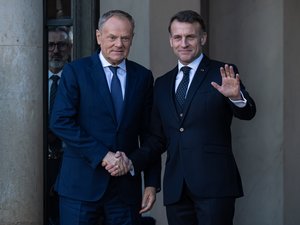
President Emmanuel Macron and Polish Prime Minister Donald Tusk convened on April 20 in Gdansk, Poland, to fortify bilateral military cooperation. This pivotal summit, emphasizing “advanced” nuclear deterrence, the defense industry, and satellite development, aims at reinforcing Europe’s sovereignty amid rising tensions with Russia and the United States.
## Objectives of the Summit
This gathering is a significant step in implementing the Treaty of Friendship and Enhanced Cooperation, signed on May 9, 2025, in Nancy. The treaty reaffirms Poland’s status as a key ally of France, alongside Germany. Given the backdrop of the ongoing conflict in Ukraine and escalating tensions with the U.S., the focus on security and military cooperation emerges as a top priority.
Prime Minister Tusk emphasized, “We hold closely aligned views on strengthening Europe’s collective security and sovereignty.” This statement encapsulates the essence of the summit: fostering unity among European nations against external threats.
## Nuclear Deterrence at the Core
Central to the discussions is the “advanced” nuclear deterrence framework proposed by Macron on March 2. This initiative seeks to involve eight European nations, including Poland and Germany, in joint military exercises and possibly stationing French aircraft equipped with nuclear capabilities within allied territories. This collaborative approach is intended to bolster collective defense mechanisms across NATO.
Macron is accompanied by key ministers from the Army, Foreign Affairs, Energy, and Culture, signaling the multifaceted nature of this partnership.
## European Preference in Defense
Another critical focus of the summit involves “European preference” in defense procurement. Macron’s advocacy for enhanced European military autonomy aims to reduce dependency on U.S. armaments, which could potentially strain relationships with Eastern European nations that support the existing alliances with the United States.
Discussions will also revolve around the tenders for a second Polish nuclear power plant, in which the French energy giant EDF is keen to participate. This endeavor is part of a broader strategy to synergistically link energy and defense initiatives.
## Cultural and Economic Dimensions
Beyond military cooperation, the summit seeks to bolster cultural ties, with plans for a cross-cultural season in 2027. This initiative aims to deepen understanding and cooperation between France and Poland in various cultural dimensions. Additionally, with Poland committing to spend over 4.8% of its GDP on military modernization by 2026—far exceeding its European counterparts—this summit could set the stage for significant defense industry collaborations.
## The Road Ahead
The meeting also marks a welcome shift in Hungary’s political landscape after the recent electoral defeat of Prime Minister Viktor Orban, allowing for a more unified pro-European agenda. As both France and Poland acknowledge their shared objectives, this summit serves as a vital platform for laying the groundwork for an increasingly secure and autonomous Europe.
By enhancing military cooperation and asserting a collective voice in international affairs, France and Poland are positioning themselves as pivotal players in the quest for a stable and sovereign European Union. This summit in Gdansk is not just a meeting; it symbolizes a commitment to a stronger, more cohesive Europe prepared to confront future challenges.