
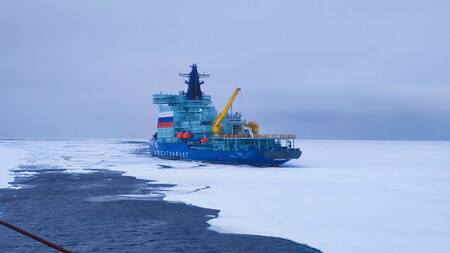
For centuries, Arctic ice has posed significant challenges to navigation, presenting not only extreme temperatures and rough seas but also ice plates capable of closing entire routes for extended periods. In such conditions, clearing a path for vessels relies on specialized machinery: icebreakers. According to the Center for Strategic and International Studies (CSIS), Russia boasts the world’s largest fleet of icebreakers, both nuclear and non-nuclear. This capacity is crucial for logistics, economic activities, and asserting state presence in one of the globe’s most contested regions.
Among the latest advancements in this fleet is the nuclear icebreaker “Yakutiya”. Part of Project 22220, this ship was designed to enhance annual navigation in the Russian Arctic and facilitate transit along the Northern Sea Route. Constructed at the Baltic Shipyard in Saint Petersburg and operated by Atomflot, Rosatom’s icebreaker division, the “Yakutiya” is a key asset for maintaining maritime activity in Arctic waters.
A Boat Designed for Challenging Conditions
World Nuclear News reported that as of October 10, 2024, the first of the “Yakutiya’s” two RITM-200 reactors achieved minimum controlled power after fuel loading and testing. By December, the vessel completed pre-delivery sea trials, and by April 2025, it was en route to its home port in Murmansk, with plans to sail deeper into the Kara Sea to support operations in the Western Arctic.
The defining features of the “Yakutiya” go beyond its construction timeline. According to Rosatom, the icebreaker measures 173.3 meters in length and 34 meters in width, enabling it to create channels wide enough to accommodate large vessels. It displaces around 33,000 tons and can achieve speeds close to 22 knots (about 40 km/h) in open water. Its standout capability is breaking ice up to three meters thick, making it uniquely equipped to tackle the harshest conditions.
These icebreakers are classified as universal nuclear icebreakers, designed to operate in both open seas and shallow Arctic areas, including the mouths of Siberian rivers. This versatility significantly extends their operational reach along the network of Arctic routes, where conditions can vary greatly between regions.
Furthermore, the “Yakutiya” can escort large commercial vessels, including oil tankers and liquefied natural gas carriers. Built to last, each unit has an estimated operational lifespan of at least 40 years and accommodates a crew of around 75 personnel.
The Strategic Importance of the Northern Sea Route
To grasp why Russia invests heavily in ships like the “Yakutiya,” one must analyze the Arctic geography. The Northern Sea Route runs along Russia’s northern coast, linking the Bering Strait with the Kara Strait (known as Kara Gate), which CSIS emphasizes as vital for Moscow’s economic and security strategies. This passage facilitates resource transportation and reinforces Russia’s presence in an increasingly contested area.
The “Yakutiya” is a critical element of Russia’s commitment to maintaining maritime transit in extreme conditions. The future of Russia’s icebreaker fleet hinges on its ability to expand and modernize amidst a complex international landscape and an industry facing external pressures.
Images | Rosatom | Atomflot