
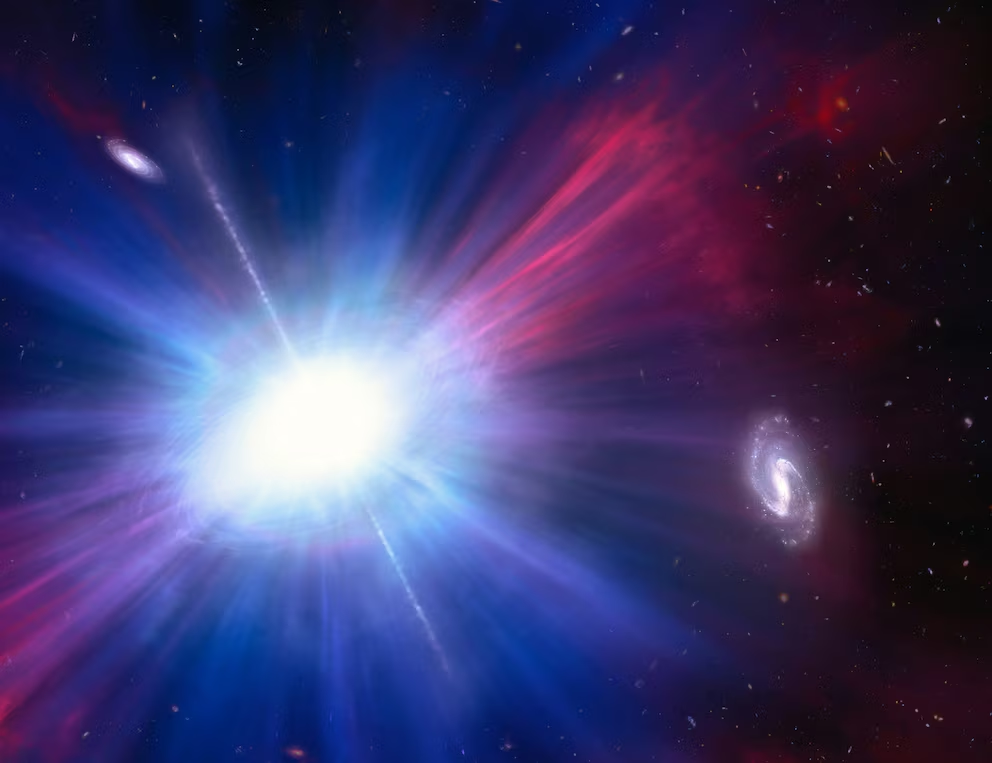
Detected Explosive Death of a Massive Star: Unveiling Cosmic Mysteries
Credit: NASA, ESA, NSF’s NOIRLab, Mark Garlick, Mahdi Zamani
Discovery of a Distant Supernova
The James Webb Space Telescope has enabled astronomers to observe a remarkable supernova from the dawn of the universe, just 730 million years after the Big Bang. This supernova, designated SN in GRB 250314A, provides a rare glimpse into the final stages of a massive star’s life from an era when the first galaxies were taking shape.
Importance of the Observation
Researchers from University College Dublin underscored the significance of this finding, which alters our understanding of stellar evolution in the early universe. Dr. Antonio Martín-Carrillo, co-author of the study, stated, “The key observation connecting the death of massive stars to gamma-ray bursts (GRBs) is the detection of a supernova at the same celestial location.”
Intricate Analysis of the Explosion
The event was initially captured on March 14, 2025, when the space-based Variable Object Monitor (SVOM) identified a powerful long-duration gamma-ray burst. Follow-up studies using the Very Large Telescope confirmed its extreme distance, making it one of the oldest supernovae recorded.
Approximately 110 days after the initial burst, the Near Infrared Camera (NIRCAM) on the James Webb allowed scientists to isolate the explosion’s light from its underlying host galaxy. This differentiation enabled a thorough analysis of the early supernova event.
Insights into Stellar Evolution
The study found that most long-duration gamma-ray bursts are linked to the collapse of massive stars, making them essential indicators of star formation throughout cosmic history. The researchers observed that the properties of supernovae following gamma-ray bursts provide insight into the characteristics of the collapsing star.
Moreover, the comparison with current models showed that the observed supernova matched expectations derived from stellar deaths in the local universe, illuminating the galaxy that hosted the dying star.
Unexpected Findings and Future Research
One notable aspect of the study is that the identified supernova’s luminosity and spectral features closely resembled SN 1998bw, a well-known supernova associated with a gamma-ray burst in the modern era. This observation challenges the prior belief that extremely low metallicity environments would produce brighter explosions. Instead, the data suggest a surprising uniformity in these stellar deaths across vastly different cosmic conditions.
Astrophysicists plan to conduct follow-up observations with the James Webb in the next year or two. As the supernova dims, these additional analyses aim to deepen our understanding of its host galaxy and its cosmic implications.
In conclusion, the innovative use of the James Webb Telescope continues to unravel the complexities of the universe, highlighting significant cosmic events like the explosive death of massive stars and their broader implications for our understanding of existence.