
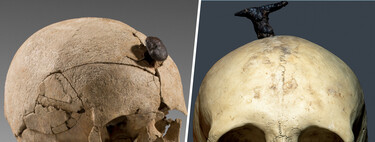
Unveiling the Cubic Skull of Tamaulipas
Modern archaeology has recently uncovered a striking find that challenges our understanding of ancient cultures in northern Mesoamerica. A team from the National Institute of Anthropology and History (INAH) has discovered a cube-shaped skull in Tamaulipas, presenting a unique opportunity to revisit historical narratives.
Astonishing Discovery
This unusual skull, with what is described as “parallelepiped” deformation, was found in the archaeological zone of Balcón de Montezuma, nestled in the Sierra Madre Oriental. As reported by the INAH, the remains belong to an adult male over forty years old, dating back to the Classic period, which spans from 400 to 900 AD.
Understanding the Deformation
While the cube-like shape of the skull astonishes at first glance, the real revelation lies in the method of modification known as “erect tabular,” specifically in its “parallelepiped” variant. Previous methods of cranial deformation have been recorded in the region, but this particularly novel form raises eyebrows.
Techniques Behind the Deformation
Scholars believe that the ancient inhabitants of this area utilized wood compression devices, including slats, to alter skull shape. Applied during childhood, these devices restricted natural bone growth, allowing for the deformation desired by the caretakers.
Who Was This Individual?
The discovery has prompted anthropologists to question the identity of the skull’s owner. Initially, the unique deformation style was linked to Mesoamerican cultures in the southeast. This raises a significant question: was this man a foreign migrant?
Strontium Isotope Analysis
Thanks to strontium isotope analysis, researchers have conclusively determined that the bones belonged to a local man born and raised in the Sierra Madre Occidental. This finding transforms our understanding from that of migration to a narrative of cultural adoption and integration.
Implications of Cultural Adoption
The alteration of the skull suggests that local customs or familial decisions led to this unique characteristic. It is posited that this skull modification could signal allegiance to local elite status, marking an individual as part of a higher social stratum. Furthermore, it may reflect a broader cultural exchange, indicating that aesthetic ideas circulated more freely among various communities than previously believed.
Going Beyond Isolation
Archaeologically, cranial modifications in northern Mesoamerica have generally revealed a backward inclination. The elongated upward shape seen in this new finding disrupts the prior assumption of cultural isolation in the region. Instead, it illustrates that the northern boundaries of Mesoamerica were actively intertwined in the cultural and ritual dynamics of the wider subcontinent.
A New Perspective on Mesoamerican Culture
This cube-shaped skull serves as a pivotal physical piece of evidence that enriches our understanding of ancient social practices. It underscores the complexities of identity, cultural adoption, and the fluid interaction between diverse Mesoamerican societies.
In conclusion, the findings from Tamaulipas not only captivate our imagination but also instigate a deeper investigation into the integration and cultural exchanges within ancient Mesoamerican civilizations.