
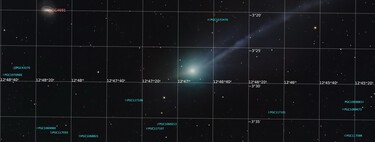
In recent months, the astronomical community has been abuzz with controversy over photos of the interstellar object 3I/ATLAS taken by NASA. Speculation swirled about why these images had not been published sooner, leading to a barrage of theories and accusations. However, NASA has now revealed the findings, putting many of these speculations to rest.
A Little Context on 3I/ATLAS
3I/ATLAS was first detected by the ATLAS system as it traversed our solar neighborhood. Following its discovery, segments of the scientific community, particularly those intrigued by the idea of extraterrestrial intelligence, closely tracked its trajectory. This interest was heightened when cosmologist Avi Loeb posited that 3I/ATLAS might be an artificial object, further fueling the debate around its nature.
The delay—approximately a month and a half—in releasing images of 3I/ATLAS, particularly taken during its close approach to Mars, only stoked the flames of speculation. Silence, initially attributed to a U.S. government shutdown, has finally been broken, with NASA now ready to share an extensive set of data.
Navigating Speculation: NASA’s Official Stance
NASA has mobilized 12 spacecraft to observe this mysterious visitor from beyond our solar system. The agency’s message strives to ground public speculation: 3I/ATLAS “looks like a comet and behaves like a comet.” Amit Kshatriya, a top official at NASA, addressed these claims during a recent press conference.
Interestingly, 3I/ATLAS may differ from traditional comets found within our solar system. Its composition, rich in nickel and emitting carbon dioxide instead of water, may suggest it formed in a chemically distinct environment, potentially around a much older star.
The Unique Observational Campaign
What makes the recent campaign exceptional is the geometry of 3I/ATLAS’s path. When it passed closest to the Sun in late October, Earth was positioned unfavorably, obstructing our direct view. NASA leveraged this opportunity, utilizing Mars’s advantageous position.
The Mars Reconnaissance Orbiter managed to capture high-resolution images from approximately 30 million kilometers away. In addition, the MAVEN mission analyzed the comet’s ultraviolet makeup, and the Perseverance rover managed to detect a faint flash from the comet’s surface.
Spacecraft like Psyche and Lucy, on their way to distant asteroids, successfully recorded the comet silhouetted against sunlight, revealing intricate details of its tail and coma. Further monitoring was accomplished by the SOHO and STEREO solar observatories when other telescopes could not observe 3I/ATLAS due to its proximity to the Sun.
What Does Avi Loeb Say?
Harvard astrophysicist Avi Loeb expressed disappointment in NASA’s findings. He criticized the agency’s press conference for confirming what he views as mundane. His skepticism rests on three primary arguments:
- The mass of 3I/ATLAS is astonishingly large—one million times more massive than ‘Oumuamua. He argues that we should have encountered numerous smaller interstellar objects before such a significant one, unless it was intentionally sent.
- Loeb proposes the “camouflage theory,” suggesting that an interstellar probe could accumulate a layer of ice and dust, masquerading as a comet as it nears the Sun.
- He points out that NASA’s released images remain blurry due to the limitations of the probes, leading him to rely on imagery from amateur astronomers as 3I/ATLAS approaches Earth.
What’s Next for 3I/ATLAS?
As it stands, NASA has reported no signs of technosignatures or intelligent maneuvers associated with 3I/ATLAS. However, the story isn’t over yet. The comet is expected to make its closest approach to Earth on December 19, 2025, at a distance of approximately 270 million kilometers. At that time, the James Webb Space Telescope and large terrestrial observatories will conduct comprehensive analyses, providing a more definitive understanding of this intriguing interstellar traveler.
Image source: POT
For further information, refer to the report on 3I/ATLAS’s non-gravitational acceleration, suggesting other forces at play in its movement.