
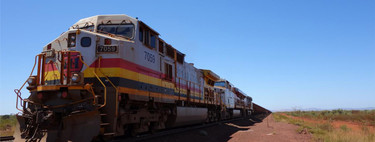
The BHP Iron Ore: The Longest Train in History
The train serves as the backbone of numerous economies around the world. While Europe and Latin America continue to develop their rail systems, countries like China and Japan rely heavily on trains for transportation. In Australia, trains are especially vital for transporting goods. In this context, 2001 marked a pivotal year when the BHP Iron Ore train in Western Australia made history as the longest train in the world, measuring an astonishing 7.3 kilometers.
Why the Need for Long Trains?
Mining Industry Challenges
Australia’s mining industry is a powerhouse, tasked with transporting increasing amounts of ore to export ports. In the late 1990s, mining companies faced mounting logistics challenges to keep costs down without inflating prices. Traditional methods, such as adding more trains to the operations, proved inefficient due to escalating fuel costs, infrastructure usage, and crew salaries.
A Revolutionary Idea
Enter BHP, one of the world’s largest mining companies, with a bold solution: instead of increasing the number of trains, why not create one massive train? This idea laid the foundation for the Iron Ore train, a project that would redefine logistics in the mining sector.
Specifications of the BHP Iron Ore Train
The dimensions of the BHP Iron Ore train were nothing short of extraordinary. Comprising 682 wagons and 5,648 wheels, it achieved a loaded weight close to 100,000 tons. To pull this colossal structure, eight GE AC6000CW locomotives, each generating 6,000 horsepower, were strategically distributed along the train.
Journey Efficiency
This massive convoy completed a 275-kilometer journey from Yandi, carrying iron ore from the Newman mines to Port Hedland, in just ten hours. Although the train operated at a slow pace, its main achievement was not merely setting a Guinness World Record, but demonstrating a groundbreaking technology known as Distributed Power.
The Distributed Power Technology
The innovation behind the Iron Ore train revolves around the concept of Distributed Power. This technology allows locomotives to be spread out along the length of the train, rather than concentrated at the front. This setup leads to more efficient traction and braking, contributing to overall operational efficiency.
Precision Control
Using a system called LOCOTROL, the front locomotive could communicate with the rear units through radio frequencies, synchronizing acceleration and braking. This sophisticated communication reduced lateral forces and friction, making cornering smoother. Additionally, it’s estimated that this technology saved between 4% to 6% in fuel consumption.
The Pilbara Region and Future Developments
The train’s remarkable capabilities were primarily utilized in the Pilbara region of Australia. However, the BHP Iron Ore train was a unique event, largely a one-time demonstration, leading BHP to focus on applying the technology to smaller, more manageable trains—typically four locomotives with around 270 carriages, still clocking in at impressive lengths of about three kilometers.
Innovations Ahead
BHP’s future ambitions involve electrifying these trains and using regenerative braking to harness energy during downhill travel, a sustainable practice other companies are also exploring in Australia.
A Legacy in Train Innovation
Even over two decades later, the BHP Iron Ore train holds an unmatched record in length and weight. Recently, Indian Railways attempted to set a new benchmark with the Rudrastra, a 4.5-kilometer train powered by seven locomotives, but it still falls short of the BHP record. Similar efforts in Europe also pale in comparison, with tests limited to just 1.5-kilometer trains.
Conclusion
The BHP Iron Ore train remains unrivaled in the world of rail transport, illustrating how innovative technology like Distributed Power can reshape the logistics landscape. As rail technology continues to evolve, the quest for longer and more efficient trains persists, but surpassing the legacy of the Iron Ore train may prove to be a daunting task.
Images | Wabtec, BHP